

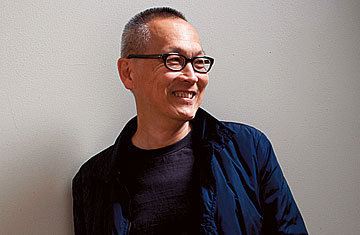
Wayne Wang, the director of The Joy Luck Club
Is it true that you're named after your father's favorite actor, John Wayne?
Terry Ramsdell, Ann Arbor, Mich.
He was interested in finding a word that sounded like Wayne. He found a word, ying, which means the bud of a tree. But that word, as a name, is quite feminine. So because he wanted to name me after John Wayne, he ended up with a very feminine name for me.
How do Chinese-Americans differ from other American minorities?
Li Nie, Washington
If I have to define the difference, it's that Chinese-Americans are more specifically tied to the old country, to traditional Chinese culture.
What's the biggest misconception Americans have of China?
Gloria Lepp, Portland, Ore.
Americans still think that people in China are peasantlike and backwards. The other stereotypes are the sword-fighting films, dragon ladies, and triads from Hong Kong. That's why for me it's so important to make movies about the real people.
When you came to the States, you stayed with a Quaker family. How did that experience affect you?
Andrew Sun, Los Angeles
It was during the Vietnam War era, so my eyes were opened to a lot of things about the world: democracy, freedom, choices and the responsibility that is tied to freedom and choice. In [the new film] A Thousand Years of Good Prayers, the daughter says, "I learned a new language, I learned a new culture and became a new person." And that's really what I went through.
You've made Hollywood movies. Why come back to making independent films?
Paul Moore, Boston
I was really curious about how the studios worked, how mainstream movies were made and how I could use my sensibility within the studio system. Now I've come back to the indies because I got on that treadmill and I couldn't get off for a while.
What do you intend to convey with your two new films, A Thousand Years of Good Prayers and The Princess of Nebraska?
Dawn King, Changsha, China
They're two sides of the same picture. They're about two different generations of women from China, who are both in America now but have very different pasts and very different futures. There's one that's trying to forget her past and find a new identity and the other one doesn't really have a past and is trying to give herself an identity.
Will your new films be released in mainland China?
Sophie Li, Guangzhou, China
I hope that Princess of Nebraska will be put on YouTube [in China] and released for free. Thousand Years was originally supposed to be financed by a Chinese company and then it fell apart because there were lines in the movie that they felt very sensitive about. You never know what they're looking for in terms of censorship.
What film directors have inspired your work?
Alan Eggleston, Grand Rapids, Mich.
Thousand Years was very much influenced by a Japanese director called [Yasujiro] Ozu. Princess of Nebraska is a tribute to the French New Wave — to directors like Jean-Luc Godard.
What makes you choose a script?
Marie Yuen, Chicago
I'm always looking for things that surprise me, things that are on a small and personal scale. Not things that hit you over the head, but things that are more indirect.
What advice would you give to aspiring Asian-American filmmakers who may feel ostracized from the mainstream?
Jennifer Chun, Wellesley, Mass.
I wouldn't try to deal with feeling ostracized. Just ask yourself, Why do you want to make films? If there's a story you really want to tell, then there are ways you can make that film.