

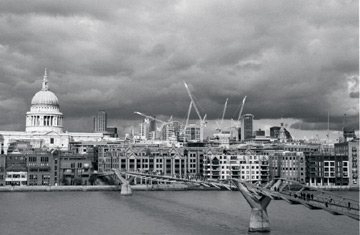
THE SKY FALLS: After 15 years of growth, London is headed for hard times
When the 4,500 people who used to work for Lehman Brothers in London showed up at the investment bank's plush office on Canary Wharf on Sept. 15, only to be told that the firm was out of business and that they should look for another job, some of them did what any number of their colleagues around town have been doing for years: they threw a party. On the equity-trading floor, the internal PA system known as the "hoot" blared out the R.E.M. song "It's the End of the World as We Know It." And then, after collecting up their personal possessions, dozens of the Lehmanites crossed the concourse to the pub just opposite, All Bar One, where they drowned their sorrows in style, accompanied by friends from other banks in the area. "People were spending five or six hundred pounds on champagne," recalls a member of the bar staff.
It was a fitting end to what has been a remarkably bubbly period for London. Over the past decade and a half, ever since its last protracted downturn, the British capital has transformed itself into Europe's indispensable financial center. Leaving Frankfurt and Paris in the dust and encouraged by the policies of Gordon Brown, the current British Prime Minister, it has become a magnet for people, jobs and investment from around the world. The big U.S. banks made London their international hub, and the major continental European banks moved much of their trading and investment banking operations there. About 70% of international bonds, one-third of the world's foreign exchange and almost half the total volume of international equities are traded in London, more even than New York, its only remaining rival as the world's financial capital. Hedge funds piled into Mayfair on the heels of private-equity players. Any self-respecting Russian oligarch has a Knightsbridge mansion, sends his kids to élite private schools and has listed his company on the London Stock Exchange. Affluent Chinese, Indians, Middle Easterners and many others are not far behind.
All this activity has made the City — the square mile around St. Paul's Cathedral that is the heart of the old financial district, and the gleaming towers of the new financial district in the docklands area — a powerful motor not just for London but for British prosperity. In 2007, financial services accounted for 10.1% of the U.K.'s gross domestic product, up from 5.5% in 2001. Add in professional services linked to finance, such as accounting, law and management consultancy, and the total rises to 14%. And that's for Britain as a whole. For London, finance has been even more important: It now accounts for almost one-fifth of the city's total output, and perhaps as much as one-third if professional services are included. That's far more even than New York, where financial services are about 15% of the local economy.
But now the world is in the grips of a perilous market crunch, the boom is over and tough times loom. The U.K.'s FTSE-100 stock index has nosedived in recent days and is down about 35% in the past year. Three famous British banks have already imploded — Northern Rock, HBOS and Bradford & Bingley. And after a dramatic plunge in the stock price of other banks, the deeply rattled British government came to the rescue on Oct. 8, announcing an emergency $88 billion recapitalization package. The City has been through enough slumps to know what to expect next: layoffs, shrinking bonuses for those lucky enough to keep their jobs, and a new frugality over expenses. This will inevitably have repercussions on housing prices, but also on other types of consumer spending that boomed along with the City. They range from fancy restaurants and overpriced cappuccino bars to pricey vacations, bespoke suits and aromatherapy massages that the financiers and their legions of support staff could once readily afford.
The coming downturn is already shaping up as different — and tougher — than some previous ones. That's because the financial crisis is taking place at the same time as a real estate downturn, a conjunction that is unusual; in the past, one has often followed the other, but it's rare for them to happen simultaneously. And the problems are being exacerbated by an explosion of household debt in Britain over the past decade, which now leaves people especially vulnerable. Buoyed by rising property prices, households ratcheted up their borrowing to a massive 173% of disposable income, vs. 106% in 1995. That's way above even that paragon of profligacy, the U.S., where household debt amounts to 139% of income.
Oxford Economics, which specializes in regional forecasts and advises the British government, expects 110,000 jobs to be cut in London between this year and 2010 as the city's economy contracts — although if the credit crunch is protracted, it predicts that the number could rise to almost 150,000 next year alone. Real estate is already reeling. Plans for two huge new skyscrapers in the City have been shelved, and the price of prime residential houses in central London has dropped by 12% so far in 2008, according to realtors Savills, while sales volume is down by 50% in some areas like Clapham and Fulham. That's just the start. Vincent Tchenguiz, one of the biggest property moguls in the U.K., believes the real estate downturn will last five to seven years. "It's obvious that with a crippled financial sector the consequences won't be too good," he says. "London was helped by strong international markets, but as they're now gone, we'll see some stress."
As the gloom descends, one question is starting to make the rounds — a question that London hasn't really asked itself before: Did the City become too successful for its own good? The increasing dependence on financial services has brought in fabulous wealth in the past 15 years, but it has also left the British capital at the mercy of the ups and downs of the moneymen. As finance has soared as a proportion of the local economy, it has eclipsed other sectors. London was once a major center for industry, for example, but manufacturing now accounts for just 6% of the city's output, half the proportion of two decades ago. Has London become too reliant on a single industry, putting all of its eggs into one volatile basket? "Obviously people see it as a risk, and if there's a prolonged downturn, it will become an issue," says Andrew Goodwin, a senior economist at Oxford Economics, who nonetheless believes that while "there is a concern about dependency, financial services have done well historically." At the Guildhall, which is where the City administration is based, policy head Stuart Fraser is bracing for a slump as severe as the one in the early '90s, when house prices collapsed and unemployment soared. Still, he adds, "It's like the aircraft industry. A plane will crash occasionally but what you don't do is stop flying."