

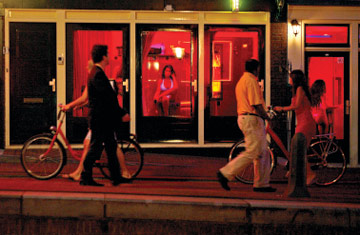
PUT ON THE RED LIGHT: Amsterdam's vibrant red-light district has long been one of the city's major tourist attractions
(2 of 2)
Residents claim that the neighborhood has changed drastically in recent years, as the numbers of Dutch prostitutes dropped and thousands of women, many from Eastern Europe, arrived to take their place. "We used to know all the prostitutes, they were our neighbors," says Gerrit van der Veen, a management consultant who has lived in De Wallen since 1972. Van der Veen, like other locals, blames Amsterdam's government for ignoring the growing presence of traffickers and pimps, preferring instead to promote the city's open-mindedness. "The government just gave away the old center of Amsterdam," he says. Cohen admits that the city missed early warning signs of criminal involvement. "It took some time before we realized that there was so much trafficking and abuses," he says.
That slow-footedness gave criminals time to wrap their tentacles around the district, as the city's first high-profile sex-trafficking trial showed this summer. Two German-Turkish brothers, Saban and Hasan Baran, were charged with running a large-scale prostitution operation, assaulting prostitutes and forcing some of them to undergo breast-enlargement operations; they were convicted and sentenced to prison terms in July. Yet despite that victory, law-enforcement officials believe many other criminals are escaping prosecution. "Girls just will not go to the police, in case these men threaten their families at home," says a police officer who didn't want to be named. He says he has seen prostitutes beaten with baseball bats and burned with cigarettes; even then, they steer clear of cops.
Yet critics of the government's cleanup argue that shutting brothels will simply lead prostitutes to become streetwalkers, leaving them still more vulnerable to abuse. "If you want to help these women, this is the not the way to do it," says Mariska Majoor, who worked as a teenage prostitute during the 1980s and now runs the neighborhood's Prostitution Information Center. She and others are pushing for more public-funded campaigns to inform prostitutes of their legal rights against pimps and traffickers, and to help those who want out to find other jobs.
At City Hall, Asscher says prostitution and the use of soft drugs will still be widely tolerated under the new plan, but that criminals will not be. The neighborhood could boom once the sex industry is "substantially diminished," he says. "Real estate investors realize this is a beautiful part of the capital that has great potential."
Behind the brothel doors, the plan has sparked unease about the future. Slim Gharbi, 43, who runs a brothel company called La Vie en Rose, believes city officials have exaggerated the area's criminality and placed its entire sex industry under suspicion. "I make so much money I would be crazy to do anything illegal," he says, sitting at a computer in which he stores personal files on dozens of prostitutes — including the necessary proof that they are over 21 and allowed to work in the European Union. Gharbi can earn thousands of euros a day by renting out 32 rooms to prostitutes in three eight-hour shifts; he keeps 15% and gives the rest to the two absentee building owners. The women charge their clients a going rate of about $75 for sex; the rooms rent for up to $225 for the shift between 8 p.m. and 4 a.m., when the tourist groups have left and the serious customers arrive. Says Gharbi, "I rent rooms just like Mr. Hilton."
Yet despite Gharbi's innocuous characterization, and La Vie en Rose's romantic name, the prostitutes who plunk down cash and collect their keys at the beginning of their shifts describe their work as tough, lonely and often sordid. Ivana, a 27-year-old Dutch woman, says she began working as a prostitute after spending two years in jail and finding no other employment when she got out. Now, she says, "I switch my mind to zero when I work." Irina, a petite Ukrainian, says she has made "a lot of money" after 10 years working in De Wallen and continues to attract steady business from "men who are alone and scared." Despite her long experience as a prostitute, she has kept her work a secret from her two children, ages 21 and 14. Monika, a 26-year-old Romanian, says she too earns well — sometimes as much as $15,000 a month — and can send money home to her parents. Yet she says her work has kept her from having a boyfriend and left her isolated from her family, who have no idea that she is a prostitute.
So far Cohen and Asscher have not explained which of these prostitutes or the thousands of others will survive the red-light district's transformation. But the city's plans have already jolted many into contemplating a different future for themselves. Monika says she thinks she will one day find a regular job — the kind she could tell her parents about. After a decade working as a prostitute, Irina has begun studying to be a Russian-language tour guide around Amsterdam. And Van Brunschot, the company executive, says he has grown tired of waiting for the city to change his neighborhood. Earlier this year he began looking for a new home, either in Amsterdam's western suburbs or in the seaside city of Haarlem. "I've told myself I'll be out by the end of this year," he says. He'll be one of hundreds leaving. But many of them have not the slightest idea where they'll end up.