

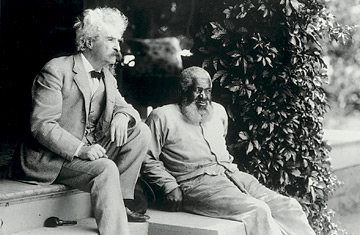
Twain with John Lewis, who may have partly inspired the character of Jim in Huckleberry Finn.
(2 of 2)
Relations between blacks and whites were hardly the limits of Twain's concern over race. His essay Disgraceful Persecution of a Boy discusses a young man arrested in San Francisco for "stoning Chinamen." After laying out the many ways in which Chinese immigrants were persecuted in California, Twain expresses little surprise that the young man might have learned to say to himself, "Ah, there goes a Chinaman! God will not love me if I do not stone him." Twain's essay About Smells notes that in Heaven, one will meet people of all races--he lists a few--but not, alas, the "good Christian friend" who spends all his time complaining.
Twain's racial pitch was not perfect. One is left uneasy, for example, by the lengthy passage in his autobiography about how much he loved what were called "nigger shows" in his youth--these were minstrel shows, mostly with white men performing in blackface--and his delight in getting his prim mother to laugh at them. Yet there is no reason to think Twain saw the shows as representing reality. His frequent assaults on slavery and prejudice suggest his keen awareness that they did not. The shows were simply a form of entertainment popular all over the country in the 19th century, a part of the background against which he grew into his firm adult convictions.
Was Twain a racist? Asking the question in the 21st century is as sensible as asking the same of Lincoln. If we read the words and attitudes of the past through the pompous "wisdom" of the considered moral judgments of the present, we will find nothing but error. Lincoln, who believed the black man the inferior of the white, prosecuted and won a war to free him nevertheless. And Twain, raised in a slave state, briefly a member of a Confederate militia, and inventor of Jim, may have done more to rile the nation over racial injustice and rouse its collective conscience than any other novelist in the past century who has lifted a pen.
Or typed on a computer.
Carter is the William Nelson Cromwell Professor of Law at Yale. His third novel, Palace Council, will be published this month by Knopf