

(3 of 3)
Conservatives tend to be particularly moved by stories of Americans showing extraordinary devotion to our patriotic symbols. McCain tells an especially powerful one about a fellow prisoner in North Vietnam named Mike Christian, who stitched a U.S. flag on the inside of his shirt and was brutally beaten by his captors in response but immediately began stitching it again, even with his ribs broken and eyes swollen nearly shut. Of course, any sane liberal would find that story stirring as well. But liberals more often lionize people who display patriotism by calling America on the carpet for violating its highest ideals. For liberals more than for conservatives, there is something quintessentially patriotic about Frederick Douglass's famous 1852 oration, "What to the Slave Is the Fourth of July?," in which the great African-American abolitionist refused to celebrate the anniversary of America's founding, telling a Rochester, N.Y., crowd that "above your national, tumultuous joy, I hear the mournful wail of millions whose chains, heavy and grievous yesterday, are today rendered more intolerable by the jubilee shouts that reach them."
How to Be a Patriot
On inspection, the liberal and conservative brands of patriotism both have defects. In a country where today's nativists are yesterday's immigrants and where change is practically a national religion, conservative patriotism can seem anachronistic. To be Spanish or Russian or Japanese is to imagine that you share a common ancestry and common traditions that trace back into the mists of time. But in America, where most people hail from somewhere else, that kind of blood-and-soil patriotism makes no sense. There is something vaguely farcical about conservative panic over Mexican flags in Los Angeles when Irish flags have long festooned Boston's streets on St. Patrick's Day. Linking patriotism too closely to a reverence for inherited tradition contradicts one of America's most powerful traditions: that our future shouldn't be dictated by our past.
By defining Americanism too narrowly and backwardly, conservative patriotism risks becoming clubby. And by celebrating America too unabashedly--without sufficient regard for America's sins--it risks degenerating from patriotism into nationalism, a self-righteous, chest-thumping ideology that celebrates America at the expense of the rest of the world.
But if conservative patriotism can be too exclusionary, liberal patriotism risks not being exclusionary enough. If liberals love America purely because it embodies ideals like liberty, justice and equality, why shouldn't they love Canada--which from a liberal perspective often goes further toward realizing those principles--even more? And what do liberals do when those universal ideals collide with America's self-interest? Giving away the federal budget to Africa would probably increase the net sum of justice and equality on the planet, after all. But it would harm Americans and thus be unpatriotic.
Eminent thinkers, from Tolstoy to contemporary philosophers like Martha Nussbaum and George Kateb, have denounced patriotism on exactly those grounds: that it's wrong to prefer one's countrymen and -women to people in other lands. Patriotism, in Kateb's words, is illiberal; it "is an attack on the Enlightenment." There's a lot of truth in that. Liberals may love America in part because it aspires to certain ideals, but if they love it only because it aspires to those ideals, then what they really love is the ideals, not America. Conservatives are right. To some degree, patriotism must mean loving your country for the same reason you love your family: simply because it is yours.
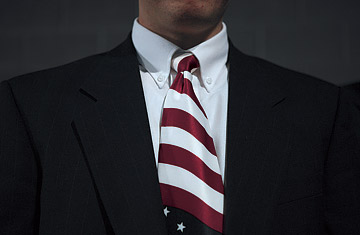
When it comes to patriotism, conservatives and liberals need each other, because love of country requires both affirmation and criticism. It's a good thing that Americans fly the flag on July 4. In a country as diverse as ours, patriotic symbols are a powerful balm. And if people stopped flying the flag every time the government did something they didn't like, it would become an emblem not of national unity but of political division. On the other hand, waving a flag, like holding a Bible, is supposed to be a spur to action. When it becomes an end in itself, America needs people willing to follow in the footsteps of the prophets and remind us that complacent ritual can be the enemy of true devotion.
Patriotism should be proud but not blind, critical yet loving. And liberals and conservatives should agree that if patriotism entails no sacrifice, if it is all faith and no works, then something has gone wrong. The American who volunteers to fight in Iraq and the American who protests the war both express a truer patriotism than the American who treats it as a distant spectacle with no claim on his talents or conscience.
And no matter how they define patriotism, Americans should tremble before suggesting that any fellow citizen lacks it. Obama's original mistake was not in declining to wear the flag pin but in saying he had stopped wearing it because he saw "people wearing a lapel pin but not acting very patriotic." And that's what makes his current adoption of the symbol so shrewd. By opposing the Iraq war in the fevered year after 9/11--when some Bush supporters branded doves unpatriotic--he has already expressed an understanding of patriotism particularly beloved by liberals: patriotism as lonely dissent. Now he is expressing an understanding particularly important to the conservatives he must court: patriotism as symbolic devotion.
McCain has bucked his side as well. He has refused to bash illegal immigrants. He has championed national service, an idea generally more favored by liberals, which helps Americans devote themselves to their country without donning its uniform. And by crusading against Washington corruption, he has acknowledged how defective American democracy often is, something Reagan, with his airbrushed patriotism, rarely did.
So is wearing the flag pin good or bad? It is both; it all depends on where and why. If you're going to a Young Americans for Freedom meeting, where people think patriotism means "my country right or wrong," leave it at home and tell them about Frederick Douglass, who wouldn't celebrate the Fourth of July while his fellow Americans were in bondage. And if you're going to a meeting of the cultural-studies department at Left-Wing U., where patriotism often means "my country wrong and wronger," slap it on, and tell them about Mike Christian, who lay half-dead in a North Vietnamese jail, stitching an American flag.
And if anyone gives you a hard time, tell him he doesn't know what true patriotism is.
Patriotism in Print For five great reads about patriotism, go to time.com/patriotism
Beinart is a senior fellow at the Council on Foreign Relations