


(2 of 3)
 |
|
|
AP
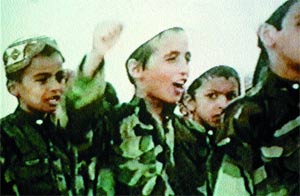
Videos show the mujahedin start training early.
|
The Spanish police did, acting on German information, on June 22, by which time the formerly sleek 40-year-old had grown a scruffy beard and melded into the transient worker milieu of Alicante. He now awaits trial with his "brothers" in France, accused of planning an attack on the marketplace in front of Strasbourgs cathedral. German police have seized a video shot from a moving car, laying out the approach and escape route and lingering on the cathedral. The soundtrack is jihad battle songs from the cars cassette deck and occasional curses from the occupants about "Christian dogs."
Ranged against those successes in cross-border teamwork, however, are some fairly spectacular instances of how the European Unions vaunted freedom of movement has far outpaced judicial cooperation. After the first arrests in Milan last April, Italian prosecutor Dambruoso issued a warrant for another figure associated with the cell, Tarek Maaroufi, referred to in Italian court papers as one of the "spiritual heads of the Salafist Group with a basic function of indoctrinating recruits." But Maaroufi lives in Belgium as a Belgian citizen, and no European Union country extradites its own citizens. The Belgian authorities contend that the Italians have not provided sufficient grounds for his arrest, nor have they seen fit to hand over his dossier to a Belgian prosecutor. A Belgian court found Maaroufi guilty in 1998 of criminal association connected to an earlier G.I.A. terrorist action, but the sentence was suspended and he never served time.
So it is, then, that Maaroufi, a hotly pursued terrorist in Italy, lives freely but under surveillance in Brussels. He heads a nonprofit organization of his own design, "the Institute for the Research and Study of Civilization." He says he researches Islam with funds solicited from Muslims in local mosques. "I am a Belgian citizen, and I respect the Belgian law," he insists. Maaroufi has acknowledged that he has visited the apartment of the arrested Tunisians in Milan, and he told Time he had traveled to Afghanistan last November, "but that doesnt mean I know bin Laden."
There is a volcano of frustration among European antiterrorist officials who feel their neighbors dont share their own commitment to knocking out al-Qaeda. Among investigators, the need for a European arrest warrant, which government leaders have vowed to adopt in early December, has become blazingly obvious. E.U. officials say the measure would radically streamline cross-border investigations. "We actually had better cooperation with German officials six or seven years ago," complains a French official, though he, like many of his Continental colleagues, reserves his deepest concern for Britain. The basic gumshoe logic of parsing al-Qaedas European network, investigators say, is to watch operatives in one cell make contact with another. The problem, says a French investigator, is that many groups that seem to work independently of one another actually coordinate their activities in London. "Since radical Islamist groups function openly and in total freedom in Britain," gripes the investigator, "how can you monitor who makes connections with whom, and who acts as the go-between?"
Mustafa Alani, Middle East security expert for the Royal United Services Institute for Defence Studies, is convinced that the U.K. has never played host to a formal al-Qaeda network — a judgment privately shared by the FBI. But London is clearly a center of coordination and direction. It appears well-established that suspected al-Qaeda operatives like Zacarias Moussaoui (detained in New York) and Djamel Beghal (detained in Paris) have imbibed the heady hatred of Sheik Abu Qatada, the Palestinian-born cleric who preaches in London and whose bank account has been frozen after appearing on a U.S. Treasury list of terrorist suspects. And like many others, Moussaoui and Beghal used London as a point of transit to and from Afghan camps.
For their part, British authorities have started to move; the Home Office says two dozen persons are under active investigation for links to al-Qaeda, of whom Lotfi Raissi, Algerian pilot accused of teaching four of the suicide pilots, has been arrested. On Tuesday, antiterrorist police arrested Yasser al-Siri, 38, an Egyptian suspected of being involved in the "commission, preparation or instigation of acts of terrorism." A self-proclaimed advocate of human rights for the worlds Muslims, al-Siris Islamic Observation Center recently publicized the warning from bin Laden military chief Mohammed Atef that Aghans would drag slain U.S. troops through the streets, "like they were in Somalia." A letter of recommendation from al-Siri is alleged to have helped ease the way for two suicide bombers posing as journalists to see Ahmed Shah Massoud, the Northern League commander fatally wounded by them just two days before the World Trade Center attack.
Investigators keen to gain insight into active cells arent terribly interested in the activities of publicists like Qatada and al-Siri, though. They want to hear details from the far less loquacious detainees, and so far theyre not hearing much of immediate value. According to a Belgian official, when police asked Nizar Trabelsi — the ex-footballer arrested on Sept. 13 for his alleged role in a planned attack on the U.S. embassy in Paris — why he had a Uzi submachine pistol in his Brussels apartment, he cited "sentimental reasons." Key prisoners like Bensakhria and the once talkative Beghal, alleged leader of the Paris plot, arent yielding up much either.