

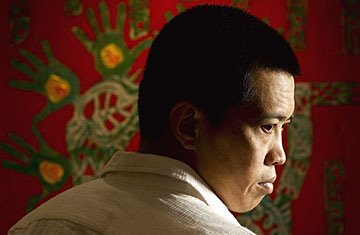
Htein Lin
Among the first paintings Htein Lin made during his 61/2 years in a Burmese prison was a self-portrait. The likeness is only passing — he had no mirror in his cell — and the line is uncertain: in lieu of a brush, he used the pieces of a disassembled cigarette lighter. The theme couldn't be clearer, however. The artist's face is enshrouded by prison bars. Yet sprouting from his head is a verdant tangle of vines that sprawls to the painting's edge — a fierce assertion that the mind, unlike the body, will not be held captive. "While I was in prison, I was concerned everybody could forget me as an artist," says the now free 42-year-old painter. "I wanted to tell the government: 'Physically, you could lock me up. But you could not lock up my ideas.'"
Htein Lin's prison experience is omnipresent in his paintings, which have been featured in recent exhibitions in both Hong Kong and London, where he now lives with his wife, a former British ambassador to Burma. His work — and unique modus operandi — is attracting the attention of international collectors, according to Karin Weber, owner of a Hong Kong gallery specializing in contemporary Burmese art that has shown Htein Lin's paintings. "They're dense with visual information," Weber says, referring to a corpus that both chronicles the artist's bodily and sensory impoverishment, and offers a timely glimpse into a country that is itself a prison to millions of its citizens. In Htein Lin's crowded, largely expressionist scenes, skeletal figures cower in tiny cells, their gaping, hungry mouths sealed by bars. Some document prison rituals like body searches and work on chain gangs. One particularly haunting canvas, Six Fingers, alludes to the prisoners' practice of chopping off their own digits with spades. "If a prisoner didn't want to go to the labor camps, he had to pay a lot of money," Htein Lin explains. "If you have no money, there's only one way to avoid it: you have to cut off your fingers. Then they could not send you to a hard-labor camp."
Despite the cruelty and tedium Htein Lin recorded, he doesn't consider himself a political artist. He was, in fact, disillusioned with politics after years of futile activism. As a law student in Rangoon, he became involved with a troupe practicing a-nyient, a traditional Burmese form of comedy that often pokes fun at the country's military leaders. When those leaders reasserted their authority in a 1988 putsch, Htein Lin, along with many other student activists, fled into the jungle. While living in a rebel camp, he happened to meet an older artist, who offered him drawing lessons using recycled newspaper or sticks in the sand and described the paintings of Van Gogh and Picasso. "I had some images of them in my mind," Htein Lin says, laughing. "Of course, it was nothing like the reality." After murderous factional violence broke out among the rebels, he returned to Rangoon, where he continued performing and drawing. In 1998, a fellow former dissident happened to mention his name in a letter intercepted by authorities, and Htein Lin was hauled off by the secret police.
In prison, Htein Lin struggled constantly and ingeniously to gather art supplies. Using a nail, he scratched poems and sketches on plastic that could only be seen when held up to sunlight. When sympathetic guards brought him house paint and syringes from the prison infirmary, he used those to create swirling, Jackson Pollock-like patterns. "If I had a lot of colors, I'd use them. If I only had black or brown, I'd use it," he says. During his seven months on death row, fellow inmates donated their sarongs — the only clothing allowed them — so that he would have something to paint on. A warden burned some of his earliest efforts, believing that they were escape maps — which, in one sense, they were — but by the time he was released in 2004, Htein Lin had managed to smuggle out hundreds of paintings and drawings.
Just as Olivier Messiaen's time in a Nazi prison camp forced the French composer to experiment with novel orchestrations, Htein Lin's years in prison gave him a technique uniquely adapted to privation. Even after his release, he has continued to paint in the primitive, almost childlike style he developed in jail. "He has this need to fill his canvases with as much as he can," Weber says, "because he may not have another chance." In a recent painting of his adopted home, for instance, Htein Lin depicts London as a chaotic welter of traffic and pedestrians. Every inch of the canvas is covered with color, as though the artist is unsure who will donate the next sarong or smuggle him the next smudge of paint. It's a subtle reminder that being out of prison isn't the same as being free.