

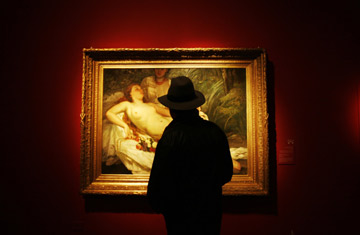
FAMILY TREASURES: The Israel Museum displays over 100 artworks stolen in World War II
(2 of 2)
At the start of the war, the Nazis looted systematically, but as the Third Reich collapsed, they plunged into an anarchic free-for-all. Allied soldiers in Germany later found stashes of plundered art in a cavernous salt mine, in castles, piled to the eaves in churches, and in the private homes of Nazis. "For the Nazis, Paris was like an art toyland," says the Israel Museum's curator, Shlomit Steinberg. "Everything was free."
The two exhibitions also reveal how much Hitler loathed the Rothschilds, the famous Jewish family of financiers and art collectors. An ex-Gestapo officer and biographer, Hansjürgen Koehler, has claimed that Hitler's grandmother once worked as a maid for the Vienna branch of the family, giving rise to rumors that she may have sired a bastard son, Hitler's father, with a Rothschild. Whatever the real reason for his enmity, Hitler, a failed art student, ordered the plunder of Rothschild collections in both Paris and Vienna to help stock his Führermuseum.
The Rothschild collections were so well known that many works were traced and returned after World War II. The Israel Museum exhibits one luminous Dutch canvas by Pieter de Hooch stolen in Paris from Edouard de Rothschild and seized by Hitler's boundlessly rapacious second in command, Hermann Goering. But greed alone hardly explains the Nazis' frenzied grasp for Jewish-owned art, says curator Steinberg: "Taking an art collection was a way of stripping the Jew of what made him a citizen in the world." Out of gratitude for French help in restoring their stolen art, the Rothschilds donated the de Hooch painting to the Louvre in 1974, and gave the Israel Museum several family portraits, which also appear in the show.
Every picture in the Jerusalem exhibition tells of avarice and loss. Not all Nazis were squeamish about possessing what the party characterized as decadent 20th century art. A work by Henri Matisse, Landscape, the Pink Wall, which had vanished during the war, was later found sealed inside a wall in the house of an SS officer, Kurt Gerstein, who committed suicide after Germany's surrender. Gerstein was in charge of delivering poisonous gas to the death camps, and faced punishment for war crimes. Other works surfaced only after the fall of the Berlin Wall. One of Delacroix's own favorites, Portrait of a Young Man, in which he portrays a pale aesthete wearing a blue cap, was found after a former German soldier on his deathbed confessed to his priest that he possessed the missing painting. The priest informed the French embassy in Berlin, which secured the painting's return to France in 1994.
Museums around the world have long had to contend with the issue of looted art. The British and French carted home priceless works from their conquests, and many museums have bought pieces stolen from archeological digs. But Nazi art plunder is an especially emotive issue because so many of the paintings were taken from Jews who later died in concentration camps amid the greatest cataclysm of the 20th century. Indeed, an exhibition like this might have been unthinkable a few decades ago, when the fate of lost treasures seemed inconsequential compared to the destruction of families and entire communities in the Holocaust. But as Snyder says, enough time has passed for visitors today to appreciate a rare glimpse of the art that, before the war, enriched the daily lives of its ill-fated owners.