

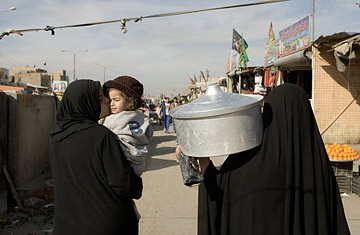
Shoppers walk the once dangerous al-Dora district
(2 of 3)
Some of the initial results worried Odierno: U.S. casualties in May and June—227 killed—were so high that even he thought he might have miscalculated. But over the summer, the landscape began to change. In Baghdad, GIs moved out of their relatively safe megabases on the outskirts and into smaller bases in the city's violent neighborhoods—to live, form networks and walk patrols. Following Saddam's model, Odierno split his troops between Baghdad and the belt towns on a 3-to-2 basis: 3 soldiers inside the capital for every 2 outside the city. By the end of June, the generals began to notice that sectarian attacks were decreasing.
Antagonists Become Allies
Petraeus and Odierno also realized early on that the insurgents could never be defeated the old-fashioned way. "You cannot kill your way out of an insurgency," Petraeus tells Time. "You're not going to defeat everybody out there. You have to turn them." And many of America's enemies were ripe for turning. Before the surge, elements of al-Qaeda in Anbar province were carrying out grisly atrocities against local Sunnis, including women and children, who refused to join the jihad against Americans. The Sunnis approached the Americans for help, and Petraeus was happy to oblige. The local uprising against al-Qaeda is known as the Anbar Awakening, and it gave the U.S. a model for turning local tribes, clans and whole neighborhoods against the insurgents.
Sometimes the incentive has been simply the will to survive; at other times, the U.S. has rushed cash, logistical help and weapons to local militias in exchange for registration of their names and retinal IDs with U.S. officials. Over the past year, the U.S. has sanctioned more than 125 local proxy armies, an ad hoc force of at least 60,000 that one could call "the other surge." Known as Concerned Local Citizens groups (CLCS), these militias serve as watch groups, police forces and eyes and ears for U.S. forces all over Iraq. But while American commanders are delighted to have help, not all Iraqis are comfortable with the CLCS. Many in the Shi'ite-led Iraqi government worry that the citizens groups—which are mostly Sunni and in some cases are little better than street gangs—will eventually morph into antigovernment militias. Lately al-Qaeda has stepped up attacks on Sunnis who take up arms with the Americans.
As former Sunni insurgents have made common cause with the U.S., one of Iraq's largest Shi'ite factions has been eerily quiet. In late August, for reasons that are still a little mysterious, Muqtada al-Sadr ordered his Mahdi Army to desist from attacking U.S. forces. U.S. officials believe al-Sadr's move was less about helping the U.S. than about purging unruly elements from his 60,000-man militia. Another interpretation is that al-Sadr is simply waiting out the surge and that his fighters will return to the fray when U.S. troops have withdrawn. Whatever the reason, Odierno reckons that al-Sadr's cease-fire is responsible for a 15%-to-20% reduction in attacks on U.S. forces over the past year. U.S. military officers are now in touch with their counterparts at all levels of al-Sadr's operation, trying to persuade them to join the peaceful coalition, as some Sunni tribes have done. But whether that invitation will be accepted—or how long the cease-fire will hold—is anyone's guess.
The surge's proponents say the main reason Iraq is quieter now than it was a year ago is that Odierno and Petraeus simply kept after the bad guys. "They went after about every safe haven at the same time," notes Kagan. "They followed up, they didn't give the enemy time to regroup and set up command-and-control centers." The strategy has been costly: 901 American troops died in Iraq in 2007, the deadliest year for U.S. forces since 2004. But Iraqi-on-Iraqi violence has dropped dramatically since the surge began, and U.S. fatalities decreased from 126 in May to 23 in December.
How Long Can It Last?
One of the most striking changes of 2007 is the relative candor with which U.S. military officers now talk about Iraq. Unlike most of their starry-eyed predecessors, when asked, Petraeus and Odierno are quick to list what isn't working well. Iraqi security forces remain unable to mount operations without the logistical help of U.S. forces. Al-Qaeda in Iraq is on the run, but it has not been routed, and it still enjoys free rein in some parts of the country. Murder, death threats and kidnappings are still commonplace; more than 100,000 sections of concrete car-bomb barriers now snake around Baghdad's neighborhoods. And in something of an understatement, even Petraeus calls the progress toward political reconciliation "tenuous." The largest Sunni bloc in parliament, known as the Accordance Front, walked out in August. In January, the parliament passed a measure that would extend to former Baathists and supporters of Saddam a measure of eligibility for service in the new government, which is largely controlled by Shi'ites. The move was long overdue, and no one knows whether the measure will ever be implemented; Sunnis are skeptical, and so, at times, is Washington. "We nudge. We push. We prod. We pull. We cajole," says U.S. ambassador Ryan Crocker. But he adds that the Iraqis "have to make the decision."
And that's the trouble. "The big problem remains that you've got a central government that is dysfunctional and disorganized, and that's being kind," says Representative Tom Cole, an Oklahoma Republican and a member of the House Armed Services Committee, who has been to Iraq seven times. Cole believes that the only thing that will compel Iraq's various factions to work together is the threat of U.S. withdrawal—something the Iraq Study Group proposed more than a year ago.
In fact, that's already happening. Several thousand troops involved in the surge have quietly begun to pull out. For now, Petraeus and Odierno are sticking by their plan to draw down U.S. forces by roughly 4,000 troops a month through July. Left unchanged, that would return U.S. forces close to their pre-surge level. But both men caution that it could be halted if violence flares up. Petraeus says further withdrawals depend on a matrix of unknowns: military and economic conditions, and whether the Iraqis are showing signs of governing themselves.
Uncertainties of that size make it impossible to know where the U.S. will be in Iraq in six months, and that's something the presidential candidates would be better off not trying to predict. Iraq is an undoubtedly safer, better place than it was 12 months ago. Yet the ultimate outcome in Iraq is out of the hands of Petraeus and the U.S. military. After a yearlong surge, the U.S. is about to move from the relatively safe ground of betting on its troops to betting on Iraqis. And that's a very different kind of wager.