

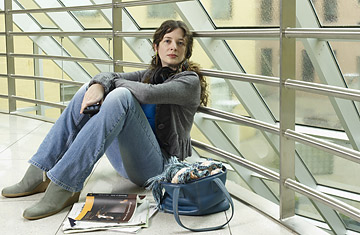
University of California at Berkeley student, Liliana Loofbourow, 27, is torn between voting for Barack Obama and Hillary Clinton
(3 of 4)
Claire McCaskill's daughter, to take one newly eligible voter, was all of 2 years old when that happened the first time. The Gingrich revolution came during her pre-K years; impeachment was around second grade. In other words, no matter how many times Hillary Clinton intones the magic word of 2008—change—it's going to ring a bit hollow, because she is an eternal piece of their mental furniture.
Obama, by contrast, radiates the new. He doesn't just talk about change; he looks like change. His person and his platform are virtually indistinguishable. Obama, like Tiger Woods and Angelina Jolie, has one of those faces that seem beamed from a postracial future, when everyone will have a permanent, noncarcinogenic tan. He has small kids and a low BMI. His voice rumbles with authority, but his ears stick out like Opie Taylor's. His campaign is crawling with cool young people, and the candidate fits right in. We've yet to see Obama flustered or harried; instead, he gives of the enigmatic Zen confidence of the guy who is picked first for every game.
His lack of experience can even seem like an asset to young voters. "I like that he's new," says Neil Stewart, 18, a freshman at the University of Colorado in Boulder. "We need some freshness in our government right now." Obama's "inexperience means he comes in with a fresh look and isn't quite as jaded by the political system as most other people are," says Jennifer Zamarripa, 26, a University of Denver law-school student. "He's new and modern and breaking with the past," says José Villanueva, 21, a senior at Claremont McKenna College in California.
It's hard to overstate the extent to which thick Washington résumés are out of vogue on U.S. campuses. Especially among young Democrats, many of whom cast their first votes in 2006 to elect a Congress that would change course in Iraq and make progress on issues like health care. The yawning chasm between what was promised in that campaign and what the Democratic Congress has actually delivered makes everyone with seniority in Washington automatically suspect. Joseph Biden and Christopher Dodd probably have socks that have spent more time in the Senate than has Obama, and look what good their years of experience did for them.
It's also true that the issues of the past are not necessarily the issues most compelling for today's students. Pollster Frank Luntz gathered a focus group of New Hampshire students on the eve of the primary there, and the hour-long conversation barely touched on the hot buttons of yore: abortion, crime and affirmative action. Their world, after all, encompasses RU 486, lower murder rates and Oprah. What concerns many of them is the nature of politics: the perceived gridlock of parties, conniving of special interests and shallow biases of the media. When Obama talks broadly about changing those dynamics, what strikes some older ears as airy and substance-free hits younger voters as the chime of insight. Washington University senior Matt Adler, 21, puts it this way, "What Obama brings to the forefront is the issue of process. It's not just what gets done but how it gets done; the morality of the process matters. Being honest, open and inclusive is an issue in itself."
Of course, young people are far from unanimous. "If we were electing someone on the basis of their ability to give great speeches, then Obama would be a great choice," says Jonathan Beam, 21, a political-science major at Emory University. "But Hillary Clinton outshines the rest of the field with her experience, and I just don't think we can afford to let another candidate get on-the-job training." While you can find students who aren't voting for Obama, though, it's harder to find students who don't recognize his appeal. "A lot of my friends from home are Republicans," says Caitlin Ellis, 20, a University of Missouri junior, "and it's refreshing not to have to fight tooth and nail with them when I say I'm for Obama."
Where Obama could be onto something truly rare is the way his campaign themes, personal story and base of support reinforce one another. Obama radiates change, which attracts young people, which in turn validates the message of change. He tells young people they can make a difference, and they decide to vote, thus making a difference. "Hope is the thing with feathers," as Emily Dickinson put it, and if Obama can make it fly, it can have deep implications in a society primed to follow the passions of youth. As cultural critic Thomas Frank explained in his book The Conquest of Cool, advertising agencies in the 1960s forever transformed youth from a demographic group to a consuming ideal. Historian T.J. Jackson Lears of Rutgers University traces the association of youth with political renewal far into America's past. "It's quite thoroughly embedded," he says. "It really begins with Theodore Roosevelt," who became President at age 42. Freshness and vitality have almost always sold better than the worry lines of veteran leadership.
TOMORROW'S DEMOCRATS TODAY
Will it happen? there are plenty of reasons to doubt. Obama's Iowa effort was long on money and loaded with time. Conditions were perfect for the slow, hard work of grass-roots organizing. Now it's the opposite. On Feb. 5, half the remaining states will vote, including those with megapopulations such as California, Arizona, Georgia and New York State. What's more, the rules are less favorable to student organizers. Iowa, New Hampshire and Nevada all had some of the most liberal voting laws in the country. Same-day registration meant that first-time voters could be swept to the polls by a last-minute appeal. By contrast, those Missouri volunteers and their counterparts in many other states face the hard fact that students who weren't registered weeks earlier will be stuck on the sidelines. They can't catch the Obama wave no matter how many times they are asked in the cafeteria.
However, Hillary Clinton also confronts the harsh math of too many states and too few resources. Super Tuesday will be another step into uncharted territory in this unusually competitive, uniquely front-loaded campaign. In the absence of wall-to-wall television ads, what role will online communications play? Will turnout remain high as campaign field operations are stretched thinner than pantyhose? If the enthusiasm wanes, who stays home—Obama's kids or Hillary's geezers? "I'm confident that we will turn out more young voters than ever before," says Riemer, "but what size piece of the puzzle that ultimately is, I just can't say."