

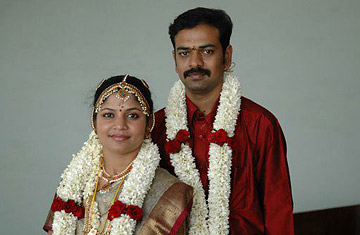
Indian matchmaking site BharatMatrimony paired up the couple. Ten million people have signed up for the site's service
(2 of 2)
But rather than dive quickly into promising markets, eHarmony has remained devoted--some would say slavishly--to its research-based model. In China, that means commissioning researchers at Beijing University to find out whether its model--in which 29 "dimensions" such as humor and spirituality are mined for compatibility--applies to the culture. Kaiping Peng, a professor of psychology at the University of California, Berkeley, who is assisting eHarmony, is unsure. "What is the best match might not be about matching exactly," he says. "Maybe it's complementary--like the yin and the yang." Americans are drawn to eHarmony's deeply probing questionnaires because as a culture we seek to know ourselves. "That probably is not necessarily the teachings of Asian philosophies and religions. Buddha used to talk about diminishing self--don't look at yourself, look at others for information and for guidance."
Perhaps those cultural differences explain why no Western company has yet won the Chinese single's hand. And what a hand: 46% of those 35 and younger are unmarried, according to a university study, and that percentage is increasing. Sixty million Internet users are of marrying age, according to Shanghai-based market-research company iResearch, a population that will grow about 20% a year, to 128 million in 2010. In Beijing alone, there are more than 2 million marriage-age singles. Local competition is rife. Chinese matchmaking sites had 14 million registered users in 2006, a number iResearch says will triple by 2010.
China should be a natural haven for online matchmaking. Up until a century ago, marriage-registration forms required the seal of an "introducer." Young, educated professionals seem open-minded. Even today, the off-line matchmaking business remains robust; there are a reported 20,000 agencies, many run by local governments and bearing such dreamy names as the Beijing Military and Civilian Matchmaking Service and the Tianjin Municipal Trade Union Matchmakers' Association. The imbalance of genders brought on by the single-child rule (many parents opted to keep only a male baby) has also led to a desperate demand for matchmakers among rural men, opening the door to unscrupulous brokers who con women into unions.
Western online matchmakers, however, do face challenges in gaining a foothold in the Chinese matchmaking market. Of the 14 million Chinese Internet daters, only 500,000 pay subscription fees; thus industry revenues are estimated at just $24 million, according to iResearch. Paying users are expected to rocket to 3 million by 2010, generating sales of at least $160 million. But fees are minimal compared with the $59 per month charged by the likes of eHarmony. "In China, if you charge money, you'll die fast," says Gong Haiyan, CEO and founder of the leading Web dating site, Jiayuan (formerly Love21cn). Chinese sites rely instead on online advertising and ticket sales from events such as speed-dating mixers that charge about $13 for admission (parents who tag along have to pay too). Another popular dating site, 915915.com.cn--in Chinese, the numbers sound like "only want me"--set up a "love cruise" in 2006 on the Huangpu River near Shanghai to introduce men worth at least 2 million yuan ($274,000) to attractive women. Edward Chiu, CEO of ChinaLoveLinks, says his free websites steer users to his 30 off-line matchmaking offices, where they can pay fees totaling up to $6,000. Both eHarmony and Match say they have yet to decide how to adjust their subscription-based models to the market.
Like China, India has a long history of and cultural comfort with matchmaking; as many as 90% of weddings are arranged, says Patricia Oberoi, a Delhi-based sociologist. There are 60 million singles ages 20 to 34, and 71% believe arranged marriages are more successful than "love" marriages. But with so many moving to cities or even abroad--up to a third of the population, according to the latest census--the Internet is proving preferable to the services of the village nayan. So-called matrimonial sites first appeared 10 years ago and today make up half the world's matchmaking sites. Like U.S. sites, they offer free viewing but charge about $40 to subscribe for three months. BharatMatrimony, a leading site, claims 10 million members and, in its 10 years, a million marriages. Another, named Shaadi, boasts 800,000 matches. Industry growth in India could be even more explosive than in China; users have doubled every year. Sales are growing 50% annually and reached $30 million in 2006. "Online matrimony has become a mainstream activity, like checking e-mail," says Uday Zokarkar, business head of BharatMatrimony.
Partly because India's matrimonial sites have already succeeded in wooing the nation, Western companies have hesitated at the door. "India is a very different business, and we just haven't got there yet," says Match's Enraght-Moony. For instance, sites there make matches on the basis of factors unfamiliar to outsiders, including caste, language and "character"--a euphemism for chastity. About 15% of profiles are filled in not by the prospective bride or groom but by their parents. And now Indian sites are challenging Western matchmaking companies on their own turf. Shaadi CEO Vibhas Mehta says 30% of its business comes from the U.S., Europe, Australia and the Middle East. Perhaps love needs no translation after all.
With reporting by Ling Woo Liu/ Hong Kong, Madhur Singh/ Delhi