

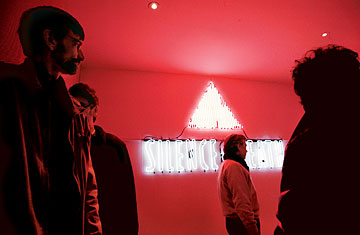
An installation at the recently opened New Museum of Contemporary Art
New York City has high taxes, infernal traffic and a perennial parking crisis. So why do people live there? One reason — one of the big ones — is that it's possible in Manhattan to have a week like this:
In the space of a single seven-day period in mid-January, I paid a final visit to an exhibition of Seurat's drawings at the Museum of Modern Art, took two children there the next day to see a show by the sculptor Martin Puryear, attended the opening night of Wagner's Die Walkure at the Metropolitan Opera, caught a couple of movies, including an old Robert Mitchum vehicle at an Otto Preminger film festival, and scored tickets to the revival of Harold Pinter's The Homecoming on Broadway. (Long Pinteresque pause here.) On the seventh day I rested.
Let's grant that as the art critic for TIME I'm in something of a special position. I'm part of what economists sometimes call the cultural workforce, someone who makes his living within the creative economy. All the same, I know from the stories told by friends and co-workers that a lot of New Yorkers have weeks that are not so different. Those economists can also tell you that the arts are a major factor, like a pleasant climate and good schools, that make a city attractive to the well-educated professionals who give a place a competitive advantage. But what people sometimes forget is that in New York, culture isn't just a lure to bring in the real producers of wealth. It's a giant moneymaking enterprise in itself, one of the biggest employers in the city. What software is to Silicon Valley, what vineyards are to Bordeaux, the arts are to New York: a mighty generator, even if not the largest one, of commerce.
When folks try to place New York in the global economy, they immediately think of Wall Street. But that's not the whole story. In 2005 the Center for an Urban Future, a Manhattan-based think tank, issued a study of the city's cultural sector, which it defined broadly to include art, design, music, theater and dance, as well as TV and film production, architecture, publishing, fashion and even advertising. It found that taken together those professions were second only to financial services as an economic force, employing 309,000 people, or more than 8% of the New York City work force.
Granted, by some estimates finance employs 20% of New Yorkers. But it is the cultural workforce, not the keepers of the counting houses, that defines the city's image, not only to itself but to the outside world. What draws so many people to New York is a fantasy of creative ferment, with themselves at the center, or thereabouts. Of course, there will always be those who dream of moving there so they can do exciting new things with municipal-bond financing or start their own hedge fund, but those people will never get their own power ballad in the second act of Rent.
A Magnet for Tourism
It's customary now for cities to use the arts as an engine of growth. Dallas is in the process of completing a whole arts district. Abu Dhabi is planning a vast one. But long before there was a Bilbao effect — the revitalization of that scruffy Basque port by Frank Gehry's Guggenheim Museum there — New York had learned to use a cultural institution for urban renewal. In the 1940s and '50s, large areas of Manhattan's Upper West Side were slums, the turf of the warring street gangs that Leonard Bernstein made famous in West Side Story. But by the early 1960s, the various components of the Lincoln Center for the Performing Arts, the first cluster of arts buildings in the U.S., were rising from their foundations. As intended by Robert Moses, the indomitable city planner, Philharmonic Hall, the Metropolitan Opera, the New York State Theater and so on transformed the surrounding streets. Almost all that remains of the run-down old neighborhood is what you can see of it in the movie version of West Side Story, which was filmed partly in the tenements, long since demolished, just west of where Lincoln Center stands.
New York's culture industry also drives another of its largest economic sectors: tourism. The city welcomed a record 44 million visitors in 2006, who managed to leave behind $24 billion. A 2005 survey by the New York-based Alliance for the Arts found 7.5 million people visited primarily to get a culture fix. This helps to explain why the city's biggest tourist attraction is the Metropolitan Museum of Art, which ushered in 4.6 million visitors in the year ended June 30, 2007. And also why, when the museum's longtime director, Philippe de Montebello, announced his retirement earlier this month, the New York Times treated it like the abdication of a king.
New York can cultivate the arts as an industry sector for the same reason that Detroit can support the production of cars: because it offers a powerful infrastructure, a network of suppliers, expertise and kindred spirits. The camera crews of TV production units have access to countless photo-equipment shops. Fashion designers can find any fabric sample among the garment-industry retailers on Seventh Avenue. The local cultural eco-structure combines nonprofit institutions that can take chances on commercially risky productions with profitmaking enterprises seeking big returns. This means that an actress can work in an off-Broadway production of The Seagull at night and still make the rent shooting a TV spot during the day. Meanwhile, a critical mass of institutions of higher education — the Tisch School of the Arts at New York University, the Fashion Institute of Technology, the Parsons School of Design, the Julliard School of Music, the School of American Ballet — are constantly training new cadres.
Yet for all the success of New York's cultural cluster, its preeminence rests on shaky ground because of something else the city is well known for: breathtaking real estate prices. By the last quarter of 2007, a year when home prices in most of the rest of the U.S. were dropping, sometimes sharply, the average cost of a Manhattan apartment was a record $1.4 million, up 17.6% from one year before. Even across the East River in Brooklyn, the average price was a hefty $661,000, up from $613,000.
At those price points, the Emerald City starts looking more like the Forbidden City, at least for people getting by on a stage designer's income. Except for the lucky few at the top, the arts do not pay. And it doesn't help that every year thousands of arts graduates tumble out of American universities and into the ranks of the city's cultural proletariat — all those actor-waiters and artist-housepainters.
The real estate crunch is a potential calamity for the arts economy. Most obviously, creative people can no longer find housing in New York within their means, even in formerly marginal neighborhoods that they pioneered, made fashionable and then unaffordable. More than that, they can't find a place to do their work. The study by the Center for an Urban Future found that almost a third of the city's "creative workforce" was self-employed, meaning that in addition to homes many of them needed their own studios, workshops, even salesrooms. And real estate is so expensive that theater groups and dance troupes can't find rehearsal space, fledgling art dealers can't establish or keep their galleries and fashion designers can't find showrooms. Look, by contrast, at Berlin. Since the Wall came down in 1989, the German capital has become a magnet for young artists from all over the world, largely because of low rents.
Network Effect
If they can't stay in the city center, of course, New Yorkers will move — as cultural workers have done for decades, migrating from the West Village to Soho, from Soho to the East Village and from there across the river to Long Island City in Queens and to Williamsburg and Red Hook in Brooklyn. But in recent years those neighborhoods, too, have been gentrifying, pushing the cultural workforce even further afield. And that art-world diaspora causes a more subtle disruption to the fabric of the creative economy. Creative people thrive on interaction. They need to be near one another to reach a kind of creative critical mass.
This was surely a factor in the rise of the first generation of Abstract Expressionists — the New York School — that included artists such as Jackson Pollock, Willem de Kooning, Franz Kline and Arshile Gorky. In the 1940s and '50s, they all lived not far from one another in a combustible concentration on Manhattan's West Side, in Greenwich Village or just south of there. From their continual friction and cross-pollination, a powerful movement was born.
There's also a purely commercial value to having like-minded people mingle. The importance of "proximity" to sustaining the arts economy of New York is one of the main premises of a recent book, The Warhol Economy, by Elizabeth Currid, a young social scientist. Currid spent months interviewing people in the creative professions, with a heavy emphasis on fashion, music and other pop-oriented fields. She concludes that "cultural producers rely heavily on their social lives to advance their careers, obtain jobs and generate value for their goods."
The government of New York City takes the cultural economy seriously. Its Department of Cultural Affairs has a larger annual budget — $131 million in fiscal 2006 — than the U.S. government's National Endowment for the Arts. The prospect of New York's real estate sector driving out its culture sector has the city worried. Last year Mayor Michael Bloomberg established an office to help nonprofit groups, especially those in the arts, to find affordable space and attract financing. The city's housing agency also set up a $100 million fund to help artists buy the spaces where they live and work.
But those are just small steps. In her book, Currid proposes that the city should directly subsidize artists, designers and musicians. The Center for an Urban Future wants the city to emulate London, which three years ago organized Creative London, a public-private partnership that coordinates strategies to support creative industries and offers assistance with financing, real estate and marketing.
In the end, it may be that nothing can resist the gilded wrecking ball of the developers. But the struggle to find some way out will determine whether New York remains a city where you can see Seurat, Pinter and Wagner all in one week, or become a place where the only music that counts is the jingle of coins.