

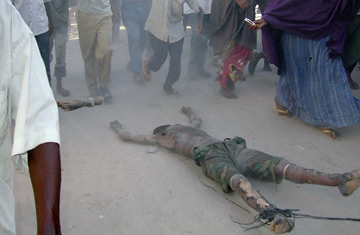
A crowd of Somalis beat the body of an Ethiopian soldier as it is dragged in the streets of Somalias capital on November 8, 2007.
(2 of 2)
It was then that the U.S. seized its moment. "We saw what was happening as the chance of a lifetime," says a Pentagon officer--"a very rare opportunity for the U.S. to move directly against al-Qaeda and get these terrorists." Meles says, "U.S. air assets were used for bombing on two occasions." The first attack was on the night of Jan. 7, after U.S. special-operations forces picked up intelligence that Fazul and Aden Hashi Ayro--a notorious and ruthless Afghanistan-trained militia leader--were riding in a convoy close to Ras Kamboni. According to an Ethiopian officer who was present, a local herdsman was paid to walk past the convoy and drop an electronic beam, which guided the air strike. Ayro was wounded. Initial media reports said Fazul was dead, but U.S. officials now believe he was not in the convoy after all and is currently hiding in Kenya. U.S. Deputy Assistant of Defense for African Affairs Theresa Whelan said on Jan. 17 that eight people were killed in the attack. A Pentagon officer insists there were "no civilian casualties, no collateral damage." Meles says, "There may have been some family members of these radical Islamists with them, but this was not by any imagination a civilian or mixed convoy."
On Jan. 23, the U.S. struck again, close to the border with Kenya. (Though the nearest human habitation is the Somalian village of Waldena, GPS receivers show the strike site is just inside Kenya.) The wreckage of a convoy was plainly visible in June, with six 10-ton trucks flipped on their sides or backs and with shell casings and live rounds littering an area as big as three football fields.
It is not known who died there. But at some point in the operation, the U.S. got lucky. According to a Pentagon official, the U.S. and Ethiopians learned some months after the strike that al-Sudani, the bombmaker for the 1998 embassy attacks in Kenya and Tanzania, had been killed. "Al-Sudani is dead, done for, six feet under and pushing up daisies," says the official. Witnesses say during operations in the south, Ethiopian helicopters and planes hit vehicles up and down the border, unwittingly killing al-Sudani. According to local villagers, his body now lies in an unmarked grave among the thorn trees and scrubland swamps.
The U.S. has not publicly acknowledged al-Sudani's death, nor has it been eager to disclose the scale and scope of American antiterrorist operations carried out at roughly the same time. But they were substantial, with a significant naval presence offshore, special-operations forces and missions flown from nearby airfields, all designed to degrade the capacity of local Islamist militants. In early January, says Abdirashid Mohamed Hiddig, a member of the Somalian parliament, the Ethiopians asked him to fly to Kulbio, Somalia. There, he says, U.S. plainclothes personnel and military personnel were sifting prisoners, looking for al-Qaeda. Human Rights Watch, a humanitarian organization based in New York City, says Ethiopian and Kenyan security forces detained hundreds of suspects without charge, though most were released in May.
By summer, Ethiopian and U.S. officials were claiming that the little war in Somalia was over. Though his troops remained in Mogadishu, Meles told TIME that the operation was a "tremendous success." But the violence never disappeared. On June 1, a U.S. warship unleashed an artillery barrage on Puntland in northern Somalia, reportedly killing eight jihadis. In a four-day battle in the capital in April, some 1,000 Ethiopians and Somali rebels died. Fierce fighting broke out in Mogadishu again last month, after which tens of thousands more refugees fled the capital.
The Risk of Regional War
The transitional government in Mogadishu has fractured, with clan loyalties trumping unity. In October, President Yusuf Abdullah fired Prime Minster Ali Mohammed Gedi. (On Nov. 24, in the latest attempt to forge a working government, Nur Hassan Hussain, the longtime president of Somalia's Red Crescent Society, was sworn in as Prime Minister.) Government forces stormed the U.N. World Food Program compound in October and briefly took its head of mission hostage. And the jihadis are regrouping. Ayro, now recovered, is back in Mogadishu at the head of the UIC militia. He recently issued a proclamation hailing bin Laden and calling on Somalis to target peacekeepers. In September the U.S. embassy in Nairobi publicly warned it had intelligence that Islamist terrorists were planning to kidnap Western tourists from beaches in Kenya.
The greatest risk is of a regional war, fusing conflicts in Somalia; the Ogaden region of eastern Ethiopia, where Eritrea-backed separatists are fighting the Ethiopian army; and across the Ethiopia-Eritrea border. Ken Menkhaus, a professor of political science at Davidson College, stresses "the danger ... that all these interlocking conflicts will ignite a larger conflagration." Eritrea is now the base for an alliance of Somali nationalist rebels, the UIC and separatist Ethiopian rebels from the Ogaden National Liberation Front. In July the U.N. Monitoring Group on Somalia, based in Nairobi, said Eritrea was supplying Somali insurgents with "huge" amounts of arms. U.N. Secretary-General Ban Ki-Moon has expressed serious concern about a military buildup along the Eritrea-Ethiopia border, where the U.N. has had peacekeepers since 2001. In Somalia, a small African Union peacekeeping force of 1,600 Ugandans is charged with keeping the factions apart. On Nov. 23, the U.S. State Department said it was committed to resolving the "political and humanitarian crises in Somalia by working ... [to] facilitate the urgent deployment of additional peacekeeping forces" there.
It is far from clear how the U.S. might do that. Yet, however terrible war in the Horn of Africa may be, experience suggests that hunger kills more people there than guns do. According to the U.N., since Ethiopia invaded Somalia, 503,000 refugees have fled Mogadishu to live in hovels of twigs and plastic bags in the bush. A year ago, there were 370 refugee families at a refugee camp 30 miles (48 km) from Mogadishu. Six months later, the camp sheltered 20,000 people. Hawa Abdi, a Somali doctor after whom the camp is named, told TIME this summer, "We need doctors. We need medicine. We need food. We need shelter. But for that, we need peace." It hasn't come yet.