

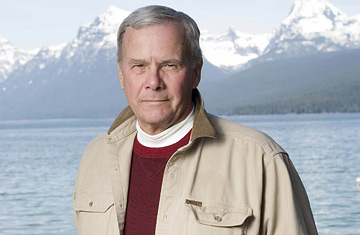
Tom Brokaw stands in Montana's Glacier National Park.
Why write about the '60s now?
ARTHUR RICE, WESTERVILLE, OHIO
It's the 40th anniversary of 1968 next year. And all but one of the presidential candidates--Barack Obama is the exception--are people who came of age during that time. That decade was the first full-throated roar of the baby boomer generation.
Why do we constantly compare today's youth and today's politics to those of that decade?
JO ANN DOUGLAS, GULF SHORES, ALA.
We're at war. It's an unpopular and divisive war. Again, the élites have the privilege of avoiding military service because it's an all-voluntary military now. We have a much bigger drug culture now than we had then. The recreational use of drugs [then], some of it was quite benign. Now it has given way to vast criminal empires that are ravaging the inner cities of this country.
Do you think America will ever regain the honor and prestige of our "Greatest Generation"?
DEBRA SEXTON, BETHEL ISLAND, CALIF.
Within every generation there is greatness. What you don't want to have America do again is to go through the tests that made the Greatest Generation: first the Depression, and then World War II.
How did growing up in the Midwest influence you?
ERIC JENNINGS, CHARLESTON, S.C.
I pledged allegiance to the flag, joined the Boy Scouts and ran for student office in school. I married a young woman I had known since we were 15. Courtship was confined to parked cars in those days. We got married and suddenly there was a sexual revolution in America.
Who was the most influential person of the past 40 years?
HEATH URIE, BOULDER, COLO.
Mikhail Gorbachev, internationally, was critically important. Ronald Reagan had a big impact on American life. So did Osama bin Laden. You can't ignore that.
What was your most memorable interview?
TERRY RAINEY, CHANDLER, ARIZ.
The most memorable interviews for me are folks whose names I don't know: young civil rights leaders in the South showing great courage as they walked into a town in the dark of the night; a doctor working for Doctors Without Borders in Somalia, operating by kerosene lantern in a tent. Those are the kinds of people that linger in your memory.
How did you react when you found out a letter with anthrax was addressed to you in 2001?
LUKE METHERELL SUNSHINE BEACH, AUSTRALIA
Here was somebody trying to kill me by sending me an anthrax-laced letter, and maddeningly, it was intercepted by my secretary, who got cutaneous anthrax. It was a very disquieting time.
Do you think it's a problem that fewer Americans now get their news from traditional sources?
MAX JACOBSON, NEW HAVEN, CONN.
We're better off. We have so many more choices. What happens is, of course, that the squeaky wheel continues to get attention. I have a little tool at my house--you should get one--it's called the remote control. You can go from those channels that are showing too much of Anna Nicole Smith to, say, BBC News.
Infotainment like The Colbert Report and The Daily Show blurs the lines between news and comedy. Do you think it meets a need that more traditional media do not?
ANTHONY W. CREECH, RICHMOND, VA.
What it does is bring in a new, younger audience to the political arena. It provokes them, I hope, into paying more attention to what is going on, and to be not just amused by it, but to be engaged in it.
What do you think of Katie Couric on CBS?
CHRISTINA PASCHYN, CLEVELAND
Katie, God bless her, was the first woman to go out there and become a solo anchor. It's not worked out as well as she would have liked it to. That's the result of a combination of issues. [But] we have female CEOs, females in the Senate and a prominent female running for President. I think the country was ready for a female anchor. I don't think this was a gender thing.
For more from Brokaw and to subscribe to the 10 Questions podcast on iTunes, go to time.com/10questions