

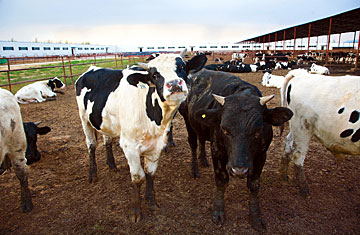
Western Cattle's Inner Mongolia ranch and feedlot is geared to the production of high-quality beef
Kevin Timberlake digs the toe of his cowboy boot into the caked earth and gives the coffee-colored dirt a scuff. Some 70 acres of scrubby land spread out in front of him under the washed-out blue sky. "See the soil. This is junk," Timberlake says. Under his breath, he counts a thin herd of cattle hanging their heads over the weeds. Once a horse trainer and breeder in Missouri, Timberlake now spends his days thinking about cows, and this time next year, he and his employer, Western Cattle Company, would like to see about 10,000 more living on this land. "I'd be taking the ground and turning it into something," he says.
Timberlake's dusty patch is not in Missouri — it's in China. Earlier this year, Western Cattle started to raise Holsteins on an American-style ranch and feedlot built in the wide open spaces of Inner Mongolia. Their goal: deliver truckloads of well-marbled beef to the waiting plates of urban China's growing middle class. With a target herd of 75,000, U.S.-based Western Cattle has the potential to be the leading company in the third-largest beef-producing nation in the world. And if the company's Western take on raising cattle catches on in the East, it could kick start the consolidation of China's disorganized beef-production chain, bringing to Inner Mongolia all the high-volume efficiency — and social and environmental concerns — that go with big agriculture.
A few years back, China wasn't much of an attraction for cattlemen. The Chinese traditionally serve beef sparingly, usually in stir-fried dishes, stews and hot pots for which tough, lean meat suffices. But the rise of McDonald's in China in the 1990s is credited with popularizing the all-beef patty, and today upscale restaurants and hotels in major cities commonly put steak on the menu. Consumption has risen 31% in the past five years alone, according to the U.S. Department of Agriculture. "The beef market is exploding," says Western Cattle president Jim Mueller. He's not exaggerating. Owing to soaring demand, China could face beef shortages as early as next year, says the Asian Agribusiness Research Center, a situation exacerbated by a dramatic decline in pork production brought on by an outbreak of blue-ear disease earlier this year. And for now, Mueller doesn't have to worry about competition from back home. Imports of beef from America — a top global supplier — have been banned in China since mad cow disease appeared in Washington State in 2003.
Mueller and his partners chose to set up their first feedlot outside Hohhot, Inner Mongolia's capital, partly because of the local government's aggressive pro-investment policies. Among other things, officials helped the company find land and provided introductions to potential business partners. Ultimately, though, it came down to the fact that Hohhot is a cow town. Two of China's biggest dairies, Mengniu and Yili, have headquarters in the area, and buy milk from thousands of farmers who raise dairy cows in their front yards. There are more than a million cows around Hohhot; the bustling city is plastered with garish advertisements for yogurt and ice cream, and nearby farming villages have developed de facto affiliations with whichever dairy buys their milk. By offering the farmers more money for milk than they earn for crops, the dairies have helped breathe life into Inner Mongolia's struggling economy.
Western Cattle is counting on the same farmers to help them push their agenda for beef. The private company doesn't breed cows; it buys them, fattens them up on a feedlot and then trucks them off to the slaughterhouse. Today, the half million male calves born every year around Hohhot are mostly sold to blood-serum companies that render the animals' plasma into products such as cosmetics. Timberlake, who is the on-site manager for Western Cattle in China, has been going head to head with serum companies since he arrived six months ago, hitting the dairies and villages with competitive offers for calves. The rangy 48-year-old, who has a salt-and-pepper moustache and shock of white hair, says he thinks he's offering the farmers a good bargain, but the deals he makes have got to be win-win. "We're here to do a service and to make money," he says. "We're not over here for our health, or I wouldn't be breathing smog."