

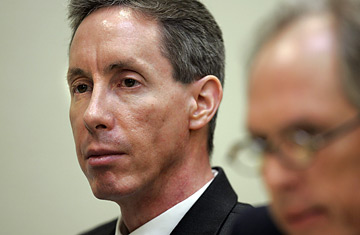
Warren Jeffs watches the proceedings during his trial on September 18, 2007, in St. George, Utah.
It was hard to listen to Jane Doe IV describe her marriage without hearing the sounds of a terrible crime. She recalled on the witness stand the moment when her new husband began undressing her. She begged that he not touch her. "'I can't do this. Please don't,'" she remembered saying. "I was sobbing. My whole entire body was shaking, and I was so scared ... He just laid me onto the bed and had sex. It hurt," she said. "And I felt evil." Later, she went into the bathroom, swallowed the contents of a couple of bottles of over-the-counter pain pills and curled up on the floor. "I just wanted to die," she said.
The man she had married was her first cousin. And she was 14 years old.
What makes the drama in the St. George, Utah, courtroom so confounding is that while this was a rape trial, the husband who allegedly assaulted Doe was a defense witness, not a defendant. And while the headlines referred to it as the POLYGAMY TRIAL, that was not the charge either, though attitudes about polygamy are clearly being put to the test. The defendant, Warren Jeffs, the 51-year-old prophet of the Fundamentalist Church of Latter Day Saints (FLDS), was being tried as an accomplice to rape for commanding Doe to agree to an arranged marriage despite her resistance and instructing her to submit to her husband "mind, body and soul" if she was to have any hope of salvation.
So this was really a case about what happens when the state's interest in protecting children runs up against a church's right to practice its beliefs, however repugnant others may find them. Jeffs' defense lawyers challenge the very notion that he should somehow be held responsible for what goes on in the privacy of a marriage simply because he arranged it. But state prosecutors have long looked for some way to penetrate the remote FLDS enclave, whose apostate refugees tell stories of exploitation of children as workers, of incest and of sexual abuse. Sitting in court amid the throngs of reporters and silent church members was Utah attorney general Mark Shurtleff, a Republican and a practicing Mormon, come to offer moral support to his team. He has called Jeffs "a religious tyrant, a demagogue" with an "absolute disregard for the laws of the nation, of the state." But charges involving polygamy are notoriously hard to prove, especially in a sect so secluded, so protective and so intent on making its own rules about what constitutes a marriage.
The FLDS was born more than a century ago when the Mormon church divided over the issue of plural marriage. Church founder Joseph Smith offered polygamy as one of the "eternal principles" of Mormonism, teaching that men would be exalted in heaven by marrying multiple wives on earth. In 1890, after years of penalties, persecution and seizure of church property, a new divine revelation inspired church leaders to reject the practice--which, among other things, paved the way for Utah's statehood. But traditionalist Mormons thought the church was selling out and established their own fundamentalist sects, which continued the practice even as the larger church condemned it.
The largest community, with some 8,000 members, settled in the twin towns of Hildale, Utah, and Colorado City, Ariz., just south of Zion National Park, along the Utah-Arizona border. It is typical for men to have three wives and about 30 children, though some have many more. Women wear their hair long and braided, their clothes modest. They will carry their iPods with them all day so they can listen to Jeffs' sermons. "Sister wives" share household chores and raise multitudes of children as their husbands rotate among bedrooms. It's virtually impossible for child-welfare officials to track levels of sexual abuse. When girls are ready to marry, they "turn themselves in" for the FLDS prophet to arrange a "celestial marriage." The husband may already have other wives, but because these are religious rather than legal unions, they do not violate laws against bigamy.
Doe first encountered Jeffs not as the prophet but rather in his earlier days as a teacher and then principal at her private church school, the Alta Academy, in Salt Lake City. He had been a top student, something of a computer geek, who trained as an accountant and liked to sing and write songs. But he was a stern headmaster, canceling an annual snow-sculpture contest because it smacked of idolatry. Doe recalled his lessons about proper conduct. Girls and boys were to treat each other "as though they were snakes," she said. "There was nothing permitted romantically." Leaving the matchmaking up to the prophet "frees you completely from all the terrible mistakes girls can make," Jeffs said. His motto: Perfect obedience produces perfect faith, which produces perfect people.
In 1998, warning of impending apocalypse, Jeffs closed the school and moved to the twin towns, where he quickly established himself as more strict and inclined to separatism than his father, the Prophet Rulon Jeffs, who died in 2002. Warren Jeffs, who inherited many of his father's estimated 75 wives, inveighed against newspapers, television, the Internet. Beware of too much laughter, he told followers, which causes the spirit of God to leak from your body. He outlawed basketball games and television and holidays, and when a child was mauled by a Rottweiler, he ordered that all the dogs in town be rounded up and killed. Men who fell out of favor were excommunicated, their wives reassigned, their children told to shun them.
Among advocates of polygamy, Jeffs stood out because he tended to arrange marriages of young girls--inspiring more mainstream-minded pluralists of the Big Love school to charge that he was giving the practice a bad name. At the same time, prosecutors were looking for a way to address growing rumors of abuses within the sect, and they turned to newly strengthened child-abuse and sexual-predator laws. In 2005, Jeffs was indicted for sex crimes in Arizona and Utah and became a fugitive. A year later, he was on the FBI's 10-most-wanted list until his arrest in August 2006 in Las Vegas. Police found $53,000 in cash as well as cell phones, wigs and laptops. When he appeared at preliminary hearings, he seemed even more gaunt than before. He was reported to have gone for days without food or water and knelt so long in prayer that he got ulcers on his knees.