

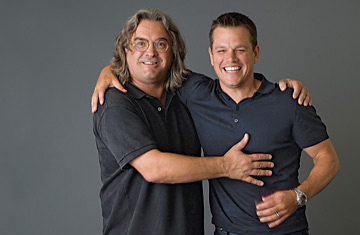
Portrait of director Paul Greengrass and Matt Damon, photographed at The Four Seasons hotel in Los Angeles, Calif., on July 20, 2007.
(2 of 2)
When they started work on The Bourne Supremacy in Moscow in 2003, Greengrass repaid his star with a priceless dose of artistic freedom. While filming a scene in which Bourne had just been shot, Damon was supposed to touch his shoulder, look at the blood on his hand and keep moving. "We were losing the light, and I was walking through this little tunnel," Damon remembers. He tried to position his arm in a way that would help the cameraman get his shot in time. "I didn't want to hold my bloody fingers below his frame. Paul came running over and said, 'No, no, no, absolutely not! Do it as you would naturally do it! Even if we miss it, we'll know what it was.' As an actor, that's like air. That's somebody saying 'I'm committed to capturing what you do naturally. I don't want you to make any adjustments for my camera.'"
And then there were the hard times, many of them on the start of the more than 110-day Ultimatum shoot. Filming a chase scene in Tangier, a busy North African port city in the middle of Ramadan meant securing contracts with more than 2,000 businesses and shutting down production when fasting crowds got cranky. As the script shifted, Greengrass and Damon shared frustrating early-morning huddles. "The two of them would sit there and talk for hours about this character," says producer Frank Marshall. They shot ill-conceived scenes, Damon says, that they knew at the time would never make it into the film. Such as? "It would be like carrying a pile of s___ in here and saying 'Look what we almost stepped in,'" he says. "When you have all this machinery and the clock is ticking and the dollars are just going out the window, most people panic. Paul says, 'All right, we're in a hole right now, and everybody needs to put down the shovel.'"
The Bourne process is, as any film-school professor will tell you, the absolutely wrong way to make an action movie. "You lay down a story, you've got to have some core objectives and some core sense of what your sequences are gonna be, and then you really have to move forward and start to make it and trust that in the process you'll find it," says Greengrass. "A film should not be an airline meal. It should not be prepacked." In other words, that edge-of-your-seat feeling of watching a Bourne movie often derives from the fact that the filmmakers are as surprised by their plot twists as their audiences are. "The camera is not gonna warn you something terrible is about to happen," Damon says.
Damon and Greengrass's improvisational style of moviemaking applied to the ordered world of the action franchise has produced a character, Bourne, wholly of the moment, rooted in the morality of today's landscape. "We all know we're in dangerous and ambiguous times," Greengrass says. "Bourne is not about wearing Prada. He's about essence, core, honesty and truth in a complex world." The movies work only because the director and star trust each other. "It's best not to look at it too close," says Greengrass of their relationship. "'Cause it's a bit like 'Why are we making such good music?' The minute you do that, you stop."