

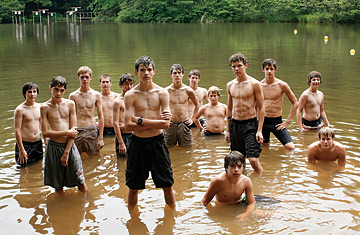
Campers at Falling Creek Camp, set in a secluded mountaintop cove near the town of Tuxedo in Western North Carolina's Blue Ridge Mountains. Falling Creek's 150-acre campus is surrounded by hundreds of acres of privately owned lush forest and beautiful wilderness.
(4 of 4)
Nothing Hodge says is remotely ground-breaking or experimental--and that's precisely the point. Only in recent decades have societies seriously begun to unlock the full potential of girls, but the cultivation of boys has been an obsession for thousands of years. "How shall we find a gentle nature which also has a great spirit?" Socrates asked some 2,500 years ago--essentially the same question parents ask today.
Ours is far from the first society to fear for its sons. Leo Braudy of the University of Southern California, in his 2003 book From Chivalry to Terrorism, noted recurring waves of anxiety. Europeans of the 18th century imagined that free trade and the death of feudalism would spell the end of honor and chivalry. Then, with the dawn of the Industrial Age, writers like John Stuart Mill worried that progress itself--with its speed and stress and short attention spans--would cause a sort of "moral effeminacy" and "inaptitude for every kind of struggle." By the end of the 19th century, a manhood malaise permeated the entire Western world: in France it inspired Pierre de Coubertin to create the Olympic movement; in Britain it moved Robert Baden-Powell to found the Boy Scouts; in the U.S. it fueled a passion for the new sport of football and helped make a hero of rough-riding Theodore Roosevelt.
All these reforms shared a common impulse to return to the basics of boyhood--quests, competitions, tribal brotherhoods and self-discovery. There was a recognition that the keys to building a successful boy have remained remarkably consistent, whether a tribal chieftain is preparing a young warrior or a knight is training a squire or a craftsman is guiding an apprentice--or Gregory Hodge is teaching his students. Boys need mentors and structure but also some freedom to experiment. They need a group to belong to and an opponent to confront. As Gurian put it in The Wonder of Boys, they must "compete and perform well to feel worthy."
The success of The Dangerous Book for Boys is one sign of a society getting in touch with these venerable truths. Nothing in the book suggests that boys are better than girls, nor does the book license destructive aggression. But it does exude the confidence of ages past that boys are to be treasured, not cured. "Is it old-fashioned?" the authors ask themselves about their book. "Well, that depends. Men and boys today are the same as they always were ... You want to be self-sufficient and find your way by the stars."
A TRIP TO BOY HEAVEN
If The Dangerous Book were a place, it would look like the Falling Creek Camp for Boys in North Carolina--a rustic paradise complete with a rifle range, nearby mountains to climb and a lake complete with swimming dock and rope swing. The choice of activities at the camp is dizzying, from soccer to blacksmithing, from kayaking to watercolors, but no pastime is more popular than building forts of fallen tree limbs and poking at turtles in the creek. Leave your cell phones, laptops and iPods at home.
There I met Margaret Anderson, a pediatric nurse from Nashville and a member of the faculty at Vanderbilt University. She works in the infirmary while her 11-year-old son Gage discovers the woods on multi-day pack trips. "I call this place Boy Heaven," she says.
Falling Creek subscribes to a philosophy of "structured freedom," which is essentially the same philosophy paying dividends among boys at the opposite end of the economic ladder at the Frederick Douglass Academy. It works across the board, says Anderson, and she wishes more of the boys she sees in her busy Nashville practice lived lives of structured freedom too.
"Whether it's urban kids who can't go outside because it's too dangerous or the overscheduled, overparented kids at the other end of the spectrum--I'm worried that boys have lost the chance to play and to explore," Anderson told me. Our society takes a dim view of idle time and casts a skeptical eye on free play--play driven by a boy's curiosity rather than the league schedule or the folks at Nintendo. But listen to Anderson as she lists the virtues of letting boys run themselves occasionally.
"When no one's looming over them, they begin making choices of their own," she says. "They discover consequences and learn to take responsibility for themselves and their emotions. They start learning self-discipline, self-confidence, team building. If we don't let kids work through their own problems, we get a generation of whiners."
That made sense to me. As I watched the boys at Falling Creek do things that would scare me to death if my own son were doing them--hammering white-hot pieces of metal, clinging to a zip line two stories above a lake, examining native rattlesnakes--I didn't notice many whining boys. Yates Pharr, director of Falling Creek, seemed to read my mind. "It's the parents who have the anxieties nowadays, far more than the boys," he said. "We've started posting photographs of each day's activity on our website, and still I'll get complaints if we don't have a picture of every camper every day."
Worrying about our boys--reading and writing books about them, wringing our hands over dire trends and especially taking more time to parent them--is paying off. The next step is to let them really blossom, and for that we have to trust them, give them room. The time for fearing our sons, or fearing for their futures, is behind us. The challenge now is to believe in them. [This article contains charts. Please see hardcopy or pdf.]