

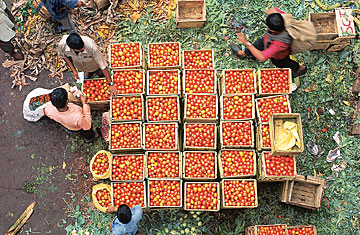
ORGANIZED CHAOS: Fresh produce mixes with rotting vegetables in Bangalore's Krishnarajendra Market
Across town, in an eight-month-old processing warehouse run by India's largest company, Reliance Industries, half a dozen women wearing balaclavas, woolen trousers and bulky jackets work inside a room kept at a constant 3C, peeling and chopping vegetables, spinning them dry and then heaping them in small plastic packets before placing them in plastic transport crates. At the other end of the 5,600-sq-m warehouse, men unload crates of grapes from a truck pulled up to a spotless loading dock. A quality-control expert samples every tenth crate; if the grapes are good a team will ready them for delivery within hours to Reliance Fresh stores around Bangalore and as far away as Hyderabad and even Mumbai (formerly Bombay). If they're not, workers will inspect the entire shipment and discard anything below standard. Uniformed men spray lemons with water, cover crates of coriander with moistened burlap to stop the greens wilting and scan bar codes on the end of each crate. Reliance will soon install air-conditioners to keep the warehouse at 18C even when the outside temperature hits 40C. "It's a luxury that not many people can afford," jokes one worker.
The Reliance operation is evidence of a retail revolution that is beginning to sweep India. The country's shopping sector is currently dominated by more than 12 million mom-and-pop stores, most of them tiny, dusty and offering a small and unreliable selection of goods. But now some of India's biggest companies have begun opening the first of what they say will be thousands of flashy new supermarkets across the country in the next few years. At the same time, foreign retail chains such as Wal-Mart and Carrefour are pressing to enter the market through joint ventures and by lobbying the government to change protectionist laws so they can set up wholly owned chains. The opportunities are immense. The McKinsey Global Institute, a think tank, estimates India's retail market will be worth $1.52 trillion by 2025, up from $370 billion in 2005. Though the relative importance of comestibles will shrink as people earn more disposable income, McKinsey estimates the food-and-beverage category will still account for 25% of all retail spending in 20 years.
Building shiny new stores to meet that demand is easy. The hard part will be supplying them with fresh, clean and safe vegetables and fruit through a sophisticated supply chain that links farms and consumers, country and cities. It's here that the real revolution lies. At the moment, India has one of the most fragmented produce-supply chains on the planet. Industry experts estimate more than 30% of all fresh produce is lost or spoils before it reaches the market. On average, goods pass through six or seven middlemen before a consumer can buy it, resulting in tortuous journeys, big markups and poor quality. Replacing that system requires not just building a modern, efficient network but adapting it to Indian conditions.
How do you set up an efficient supply chain in a place where the roads are crowded and crumbling, the power constantly fails, the water is unsafe and the bureaucracy is complicated and burdensome? How do you transform a structure so deeply entrenched and with so many powerful political backers? How do you drag a wasteful, archaic system into the 21st century? The answer: detail by tiny detail.
India's current food-distribution system is a legacy of the 1940s and '50s, when chronic food shortages led the government to crack down on hoarding of produce by unscrupulous cartels. In 1966 the government introduced a new law that banned farmers from dealing directly with retailers and forced them to sell through licensed middlemen, called mandis. The law, which also aimed to give farmers a fair and consistent price, "was initially done with a good purpose," says Arpita Mukherjee, a senior fellow at the Indian Council for Research on International Economic Relations, a New Delhi-based think tank. But over the years it grew into a monster, gaining layer upon layer of intermediaries, none of whom added any value to the fruits and vegetables they traded even as they added on their own margins. The result: a grossly inefficient system in which farmers are divorced from market feedback and often must wait months to be paid. Many farmers routinely go into debt to the very traders who buy their produce and then sell them seeds and fertilizers for the next crop. Customers, meantime, had little choice but to accept food of uneven quality and unreliable supply. "Something that was designed to protect farmers and consumers ended up hurting them," says Mukherjee.