

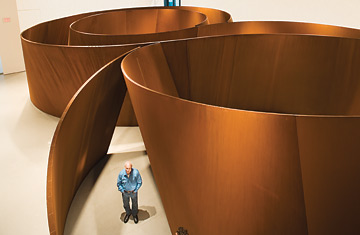
American sculptor, Richard Serra inside his piece Sequence in one of the second-floor galleries of the Museum of Modern Art in New York City on May, 16, 2007.
(2 of 2)
Then there's Intersection II, a piece that predates the Ellipses, which consists of four curved and tilted stretches of steel, positioned beside one another to form long, curving corridors that suggest those improbably angled streets in the paintings of De Chirico. Surrealism isn't something Serra thinks about when he sets out to work, but its image bank is something he admits may have seeped into his art. "Does the space in my work have a disorienting effect," he asks, "so that you can see in it the planar shifts of De Chirico? Possibly. It's not something I think about now, but there was a time in Italy when I thought about him a lot."
Serra lives mostly in Manhattan with his German-born wife Clara Weyergraf-Serra. (But he steers clear of the art world. "I don't go to scenes," he says. "I don't go to openings.") He's a native of San Francisco, the child of a Spanish-born shipyard worker and a Jewish mother who took an early interest in her son's talent as an artist. "To compete with my older brother for my parents' affections, I would draw all the time as a boy," he says. "After about the third grade, my mother started taking me to museums and introducing me as her son the artist. She also told my older brother he was going to become an attorney. And he became an attorney." He shrugs. "The strength of a Jewish mother."
At the University of California at Santa Barbara, Serra took a degree in literature. But from there he went on to Yale's famous graduate program in art. Eventually he settled in New York and started the work with lead that brought him to his triumphs in steel. The MOMA show will merely certify the stature he earned years ago. At the dawn of the 21st century, an era of cyberspace, reproduction and the Internet, no one is doing more to make work that stands for the ancient and mysterious power of the real.
The original version of this article contained the sentence “At one point Serra and his attorney at the German steel mill he works with thought of having the form trademarked.” In fact, Serra’s attorney is not connected to the steel mill.