

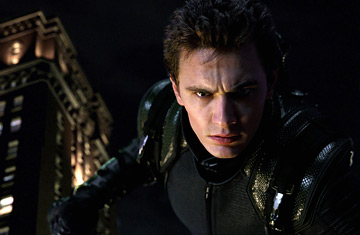
James Franco in Spider-Man 3.
Pity the poor hero. Oh, he gets the girl and saves the planet, but where's the fun in that? Love and duty are a puny match for the epochal mischief a prime bad guy can stir up. The villain may be the supporting part, but it's often the juiciest--from the snake upstaging Adam in the Garden of Eden to Shylock eclipsing Antonio to Jack Nicholson as the Joker in Batman swiping the spotlight from (hmm, who was that?) Michael Keaton.
And is summer the season of movie superheroes? No: supervillains. They get the plot spinning toward catastrophe; its their lurid schemes the hero must rise to defeat. Especially in sequels, which will dominate the box office this summer, all the ingenuity not expended on special effects goes into the creation of really nasty villains. Greed was good to villainous Gordon Gekko in Wall Street. To the producers of this summer's would-be blockbusters, bad is great.
It's not always salubrious for the actors who play the nasties. Anthony Hopkins, who, as Hannibal Lecter, was voted the No. 1 all-time villain in an American Film Institute poll (and who is currently on screens as a cunning wife murderer in Fracture), acknowledges that "audiences are drawn toward the magnetism, toward the darkness. But I don't want to glorify them. There's nothing funny or sympathetic or redeeming about them. And I don't relish playing a guy who's immoral. I've got no kind of buzz off playing monsters."
For most actors, though, including the most distinguished, playing a rotter offers a holiday from more serious fare; a nice paycheck after all those worthy little independent films; a chance to retune the actor's instrument and play it in a darker, bolder key; or just the fun of being in a movie everyone will see. We heard from a dozen of them and squirreled out the secrets of their craft: the Seven Rules of Movie Villainy.
1. FIND A REASON TO BE EVIL
BAD PEOPLE, LOCKED IN THE BASEMENT OF their dankest impulses, don't know they're bad. They think they're the good guys in a world that can't understand them, and must be punished for that mistake. Villains see themselves as victims. Actors in these roles are obliged to locate the ache or delusion at the core of the character. "The danger of playing a villain," says James Franco, who as Harry Osborn has been one of Peter Parker's nemeses in the Spider-Man films, "is that you ham it up and it becomes silly." Plausibility counts.
It counts even when you're playing an Internet terrorist, as Timothy Olyphant is in Live Free or Die Hard, the fourth in the Bruce Willis series. "One person's terrorist," the actor says, "is another person's hero." His own, usually. "So you strive for that [understanding]. At the same time you throw your hands up and say, 'Look, I'm the villain in a Die Hard movie. Don't overreach.'"
Michelle Pfeiffer, away from onscreen roles since 2002, returns in three movies this summer, two--Hairspray and the fantasy Stardust--as a villain. For her Hairspray role of Velma Von Tussle, the ex--beauty queen who can't accept the races mixing on a '60s TV dance party, Pfeiffer trawled for sympathy: "Yes, she's a bigot, but she's also a victim of the era she grew up in. It all changed on her, and what was once perfectly acceptable behavior suddenly wasn't. I think that's sad." Whereas her character in Stardust, a witch bent on destroying astral princess Claire Danes, "is just purely evil," says Pfeiffer. "I mean, she eats the heart of a star!"
2. SEE THE GOOD IN BAD
KEVIN COSTNER, A BAD GUY IN Mr. Brooks? Not quite: he's driven to murder by his alter ego (William Hurt). "He has an addiction he's trying to keep under wraps," Costner says of his character. "In life, when we see somebody trying to beat something, we feel sympathy. There's humanity inside this hideousness."
Preparing for the role of the irradiated Sandman, a.k.a. Flint Marko, in Spider-Man 3, Thomas Haden Church researched the Golem of Jewish folklore and the Frankenstein monster--creatures as pathetic as they were horrific. He wanted to give a nuanced reading of a mutant steeped in self-knowledge. "I remember the performances of Lon Chaney Jr.," he says, "where there was the physical aggression with that kind of sadness and regret that he [was] physically aggressive and could terrify people."
3. PLAY AGAINST TYPE
"AN ACTING TEACHER TOLD ME, 'PLAY YOUR villain like a priest and your priest like a villain,'" says Olyphant. "That's good advice."
As Dolores Umbridge, the bureaucrat from the Ministry of Magic in this summer's Harry Potter and the Order of the Phoenix, Imelda Staunton is a little bit priestess, a little bit villainous. Staunton, the latest in a line of top British thespians to visit Hogwart's, found it a tough balancing act: "The character has to be ridiculous and yet real and frightening. She has to be silly and yet not cartoony. It's difficult to gauge." The performance and the couture established an ostensibly soft side to Dolores. "She wears cardigans and pinks. She threatens, but if you don't listen to the words it's just a pleasant sound. She's gentle and pleasing. If she seemed hard, there would be no surprises."
4. NURSE THAT GRUDGE
"THE CLASSIC VILLAINS HAVE BEEN shortchanged," says Peter Dinklage, who's Simon Barsinister, the orotund baddie in this summer's update of the '60s cartoon series Under-dog. "They've been cheated out of something by the hero. They'll do anything to get it because they've been overlooked in the past."
That describes Rupert Everett's character in Shrek the Third: Prince Charming, who forms an anti-ogre posse of all the other fairy-tale losers, including Cinderella's stepsisters, Rumpelstiltskin and the whole sad crowd of fabled flops. Charming is their perfect ringleader; his very name suggests he was supposed to be destined for hero status. "He's a victim of circumstance," Everett notes. "He was brought up spoiled and good-looking in a culture of envy. He's quite naive and he never gets anything right. He just wants to get his happily-ever-after." And he would crush anyone for the chance.
5. PLAY THE HERO'S EVIL TWIN
HARRY OSBORN HAS BEEN STEWING IN rancor throughout the Spider-Man series--just as Franco has been skulking around the edges of the films. He's been ready for his bad-guy close-up for five years now, so, as he says, "it wasn't like I had to practice a villainous cackle or anything like that." This time, Peter has a triple-gänger: as he recognizes and fights his own weakness for celebrity, he's up against Harry, who must avenge his father's death by killing Peter-Spider. "It's two superhumans battling it out," Franco says, "but it also has a personal element, like two brothers fighting."