

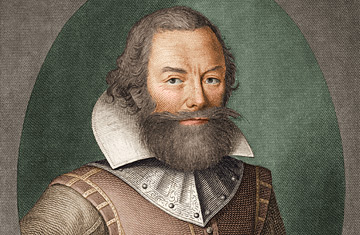
Engraved portrait of English colonist, pioneer, sailor, and soldier John Smith circa 1580 1631. Smith signed on to the Virginia Company's project at Jamestown, which became the first permanent English settlement in America.
(2 of 2)
Outlasting his detractors more than winning them over, Smith was elected president of the fledgling colony in September 1608. Chief executive, military commander and political leader of British America, Smith, at 28, had found a place at last where a man might thrive on bravado and wit. No title, no patron, no ruff-throated pretensions of nobility were required in Smith's Virginia, just an iron will to prevail--and a hornful of powder and shot.
Suddenly it wasn't only the Indians who had to deal with Smith, but also the Virginia Co. investors who funded Jamestown and were impertinent enough to expect a return. Forget it, Smith wrote his London underwriters. There was no sense digging for gold where nature had left none, he scoffed, nor would the rock-strewn James River ever guide their wind-driven square-riggers on some long-dreamed-of shortcut to China. Disenchanted investors, he concluded, were free to join him in Jamestown, where their odds of surviving were about 1 in 4.
The sealing wax on that epistle was still hardening when Smith assembled his fellow colonists for a reading of the proverbial riot act. "The greater part must be more industrious or starve," Smith decreed. "He that will not work, shall not eat." Not too surprisingly, productivity soared. Anglo-American relations played to a draw. Strains were briefly managed, tensions largely contained. What followed, though, was a long and tortuous series of missed opportunities, conflict and outright betrayal that set Smith and Powhatan on a collision course. When the old chief got word that Smith had sacked yet another village and made off with half its provisions on the eve of a harsh winter, he summoned the white man to his lodge and offered to trade in peace.
Smith rejected it, falling back instead on insults and threats. "For your riches we have no use," Smith shrugged. And if Powhatan meant to challenge the colonists' superior firepower, bring it on, Smith taunted, for "in such wars consist our chiefest pleasure."
There ended the promise of friendship for Chief Powhatan and Captain John Smith, a tragic precursor to the bloodshed between Native Americans and Europeans that was to repeat itself for centuries to come. But for all his flaws and hidebound ways, Smith avoided all-out war with the natives during his tenure, believing, for the most part, that conflict could be managed with the right mix of bully and bluff.
Smith was the only one, too, in Jamestown's first fragile years, with the ability to impose order and direction upon the bold but uneven and quarrelsome crowd that journeyed in leaking wooden boats to the far side of the world to claw out an English beachhead. "His mixture of great white father and avenging god superbly achieved what he wanted--a food supply," wrote Barbour. With the colony's survival hanging in the balance, "other questions were academic."
A national correspondent for Cox Newspapers, Deans is author of The River Where America Began: A Journey Along the James