

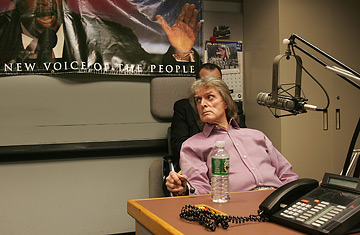
Radio show host Don Imus waits for the Rev. Al Sharpton's radio show to begin, on which Imus talked about complaints that he made racially charged comments in a recent broadcast April 9, 2007 in New York City.
(2 of 3)
The license to borrow terms other people have taken back can worry even edgy comics. A few months ago, I interviewed Silverman, who argued that her material was not racist but about racism (and I agree). But she added something that surprised me, coming from her: "I'm not saying 'I can say nigger because I'm liberal.' There is a certain aspect of that that I'm starting to get grossed out by. 'Oh, we're not racist. We can say it.'"
Comedians work through these danger zones in the presence of other comics. In a comedians' get-together or a TV writers' room, nothing is off-limits: without airing the joke that goes too far, you can never get to the joke that flies in front of an audience. Trouble might come if material meant for that smaller audience went public, as in 1993, when Ted Danson got in trouble after word got out of a Friars Club routine he did in blackface, though his jokes were defended--and reportedly written by--his then girlfriend Whoopi Goldberg.
Today, because of cable and YouTube, because of a media culture that rewards the fastest, least censoring mouth, we are all in the writers' room. (Friars Club roasts are now televised on Comedy Central.) Punditry and gonzo comedy have become less and less distinguishable. (And I'm not talking here about The Daily Show, whose host Jon Stewart is, ironically, one of the most conservative defenders of the idea of sober, evenhanded news--see his 2004 tirade against Tucker Carlson.) Got something on your mind? Say it! Don't think about it! If you don't, the next guy in the green room will! C'mon, it'll kill!
Right-wing pundit Ann Coulter is probably the best example of this, playing a constant game of "Can you top this?" with herself, as in March, when she told the Conservative Political Action Conference that she would have a comment on Senator John Edwards, "but it turns out that you have to go into rehab if you use the word faggot." Coulter is only the most egregious example--from Bill O'Reilly on Fox to Glenn Beck on CNN, offense is the coin of the cable realm.
The flip side of the instant-attention era is the gotcha era. We may be more inured to shock than ever, but when someone manages to find and cross a line, we're better able to generate, spread and sustain offense. You get eaten by the same tiger that you train. Imus got special love from the media over the years because his show was such a media hangout. But when the controversy erupted, it snowballed in part because the media love to cover the media.
Every public figure--athlete, pundit, actor--now has two audiences: the one he or she is addressing and the one that will eventually read the blogs or see the viral video. A few have adapted, like Stephen Colbert, whose routine at last year's White House Correspondents' Association dinner was decried by attendees as rude and shrill--but made him a hero to his YouTube audience. Imus, a 30-plus-year veteran of radio shock, seemed to underestimate the power of the modern umbrage-amplification machine. The day after his remarks, Imus said dismissively on air that people needed to relax about "some idiot comment meant to be amusing." Shockingly, they did not, and by the next day, Imus had tapped an inner wellspring of deepest regret.
As in so many scandals, the first response may have been the most authentic--at least we're inclined to take it that way because the contrition cycle has become so familiar. You blurt. You deny. You apologize. You visit the rehab center or speak with the Official Minority Spokesperson of your choice and go on with your life. Although--or maybe because--it's so easy to get caught today, it's also easier to get forgiven. In 1988 Jimmy (the Greek) Snyder was fired by CBS for saying black athletes were "bred" to be better than whites. In 1996 CBS golf analyst Ben Wright was suspended indefinitely after he was quoted as saying that lesbians had hurt the sport.
To his credit, Imus never played the "I'm sick" card. Perhaps he felt confident because he had been legitimized by his high-profile guests. Imus could have made a remark just as bad years ago and suffered few if any consequences. Scratch that: Imus did make remarks as bad or worse for years. Speaking about Gwen Ifill, the African-American PBS anchor who was then White House correspondent for the New York Times, he said, "Isn't the Times wonderful? It lets the cleaning lady cover the White House." He called a Washington Post writer a "boner-nosed, beanie-wearing Jewboy" and Arabs "towelheads."
Yet politicians and journalists (including TIME writers) still went on his show to plug their candidacies and books because Imus knew how to sell. "If Don Imus likes a book," says Katie Wainwright, executive director of publicity at publisher Hyperion, "not only does he have the author on, he will talk about it before, during and after, often for weeks afterwards." The price: implicitly telling America that the mostly white male Beltway élite is cool with looking the other way at racism. They compartmentalized the lengthy interviews he did with them from the "bad" parts of the show, though the boundary was always a little porous. And evidently many still do. "Solidarity forever," pledged Boston Globe columnist Tom Oliphant in a phone interview with Imus on April 9. Senator John McCain and Rudolph Giuliani said they would return to the show. "I called him a little while ago to talk to him about it personally," Giuliani told the New York Times. "And I believe that he understands that he made a very big mistake." (Senator Barack Obama, who appeared on the show once, has said he will not go back; other politicians have hedged.)
In fact, while there might be more media and blogger scrutiny of Imus' future guests, his suspension may have inoculated them--if his radio show survives. The show draws 2 million daily listeners, and it's a more valuable property on radio than it was on TV. (It brings in about $15 million annually for CBS Radio compared with several million for MSNBC.) But the show has already lost advertisers, including American Express, Staples and Procter & Gamble.
Imus argued repeatedly that his critics should consider the "context" of his larger life, including the formidable work for sick children he does through his Imus Ranch charity. But it's not Imus Ranch he broadcasts from 20 hours a week. You can't totally separate the lives of celebrities from their work--it didn't excuse Gibson that he attacked the Jews in his free time--but finally what determines who can make what jokes is the context of their work: the tone of their acts, the personas they present, the vehicles they create for their work.