

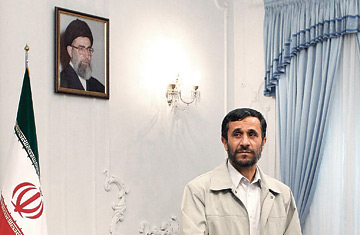
Iranian President Mahmoud Ahmadinejad after being interviewed by TIME magazine correspondent Scott Macleod in his private office in Tehran, Iran, in December of 2006.
(2 of 2)
So where does that leave Ahmadinejad? The Parliament cannot on its own dump him, and he has a little over two years left in his term. Impeachment proceedings require approval of the country's Supreme Leader, Ayatullah Ali Khamenei, who has yet to repudiate Ahmadinejad. "If Parliament senses for a second that Khamenei has withdrawn his support, the government will fall," says Atrianfar. A politician close to Rafsanjani tells Time, "Most of the decision makers and the élite are against him. If he becomes less popular, even the Supreme Leader will withdraw his support."
That's not happening yet. Ahmadinejad complements Khamenei's leadership. As a noncleric, he is not a religious rival like Rafsanjani, and unlike the reformist Khatami, who challenged some of the Islamic republic's founding tenets, Ahmadinejad supports velayat-e faqih, or rule by the clergy. He refers to the Supreme Leader as agha, a title expressing extreme deference, and kissed Khamenei's hand at his presidential inauguration.
But there are signs that Khamenei may try to rein in Ahmadinejad before he causes more trouble. An editorial in Jomhouri Eslami, a daily that reflects the views of the Supreme Leader, blasted the President for dismissing U.N. sanctions against Iran as a "piece of torn paper." A paper by the Majlis foreign-affairs committee reportedly warned about the negative economic impact of further sanctions and urged that "everything be done"--apart from sacrificing national honor--to head them off.
That may provide an opportunity for the Bush Administration. Ahmadinejad's slide has convinced Secretary of State Condoleezza Rice that the strategy of ratcheting up economic pressure on the Tehran regime is producing results. The U.S. believes the squeeze on Iran has yielded more conciliatory signals from the Iranians on the nuclear issue. The chemistry between U.S. and Iranian diplomats at a March 10 conference about Iran's future in Baghdad suggests that those favoring a resolution may be seeing some opportunities. Both sides agreed the meeting was "constructive," and U.S. Ambassador Zalmay Khalilzad termed the exchanges "frank and sometimes jovial."
Some experts believe that Khamenei will ultimately support a compromise with Western negotiators. Iranian sources tell Time that Ali Larijani, the country's top nuclear negotiator, wants to resurrect talks to resolve the nuclear impasse with European Union foreign-policy chief Javier Solana. The challenge is to find a formula that enables Iran to obtain enriched uranium for civilian energy production while allaying suspicion that it is diverting the material to a weapons program. The outlines of one such proposal have been given to Time (see accompanying article).
The bigger question may be whether the Bush Administration will ever accept Iran's motives as sincere. It's nearly impossible to imagine the U.S. striking a deal with an Iran led by an assertive Ahmadinejad, especially given his threats against Israel. And the U.S. insists it will not tolerate Iran's keeping any enrichment technologies on its soil. The emergence of pragmatic voices in Tehran, however, has made détente at least as plausible as a military confrontation. That the two sides have traveled even that far toward compromise is encouraging. But it's also a reminder of how far they still have to go.