

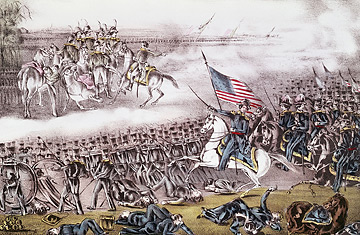
The Mexican War: The Battle of Buena Vista, Feb. 23, 1847. Undated hand-tinted 19th-century lithograph.
(2 of 2)
Today we fret about the growing partisanship and scurrilous sensationalism of the press, but our media are simply reverting to mid--19th century form. Nearly all dailies back then were extravagantly partisan, and the "sporting papers"--the Scorpion, the Sunday Flash, the Weekly Rake--provided lurid, low-down, gossipy coverage of celebrities and sex and crime.
Modern marketing was being invented as well. The 1840s saw the first national brands, the first department store, the first advertising agencies and the first presidential campaigns in which canny marketers refashioned upper-class candidates as rustic men of the people.
The words celebrity and show business came into vogue. Pop culture of every kind was exploding. P.T. Barnum operated an entertainment complex in lower Manhattan that featured stage plays, vaudeville, freak shows, a menagerie and a somewhat insane museum of natural history. In 1850, Barnum promoted the first American tour of the first international superstar--the Swedish singer Jenny Lind, for whom he stirred up such hysteria that on the day she arrived in New York, almost one-tenth of the city thronged the wharves to get a glimpse.
The pop theatrical megahit of 1848, A Glance at New York, was the first play to feature rowdy working-class characters and street vernacular. It spun off sequels so quickly--several within a year or so, produced all over the country--that it's hard not to see it as a forerunner of the broadcast entertainment series.
The core fan base for those shows consisted of working-class "Bowery boys" and "Bowery gals." Arising spontaneously in the '40s in New York City, they constituted the first American youth subculture, with distinctively over-the-top styles of dress and deportment and slang. They were foul-mouthed and rambunctious, and glorified physical violence--in practically every way the hip-hop generation of their day.
Modern American culture was dawning too. Walt Whitman and Nathaniel Hawthorne had started work on Leaves of Grass and The Scarlet Letter, respectively, and Herman Melville was preparing to write Moby Dick. Henry David Thoreau, laying the groundwork for environmentalism, was altogether disgusted by the new Zeitgeist and gimcracks. "I delight to come to my bearings," he writes in Walden, which he began in the late '40s, "not walk in procession with pomp and parade, in a conspicuous place ... not to live in this restless, nervous, bustling, trivial Nineteenth Century, but stand or sit thoughtfully while it goes by. What are men celebrating?" They were celebrating, more or less, the awesome arrival of modernity, thrilled, as well as frightened, by the shock of the new. Here, now, more than 150 years later, in this restless, nervous, bustling, trivial 21st century, some of us still are. •
Andersen is a novelist (Heyday, Turn of the Century), magazine columnist and host of the public radio show Studio 360