

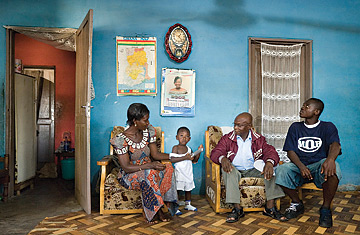
The Deh family at home: from left, Suzzy Afua Deh, her 2-year-old son Wisdom, her father Linus Kwame Deh, 72, and her son Delight Kofi Aka, in Accra, Ghana.
When midnight arrived on March 6, 1957, church bells sounded across Accra. The crowds, which had filled the city streets with the hum of celebration and hope, pushed into the square outside Parliament and cheered as Britain's Union flag was lowered and the green, gold and red colors of the new nation of Ghana were hoisted in a light breeze. In a nearby polo ground, Prime Minister Kwame Nkrumah broke into dance and then spoke of a dream finally realized. "Today, from now on, there is a new African in the world," he declared. "At long last the battle has ended. Ghana, our beloved country, is free forever." In Fodome, a small village in the eastern Volta region of the new nation, Kwame Deh, 22, and his family and friends gathered around a radio and listened through crackling static. "I felt very happy," remembers Deh. "The future was ours."
All births are incredible moments, but some are more momentous than others. When citizens of the British colony called the Gold Coast gathered to witness the founding of their new nation a half-century ago, they carried not only their personal hopes and fears but also the aspirations of a continent. As the first colony in sub-Saharan Africa to break away from its foreign master in the post-1945 era of independence, Ghana was the symbol of a land throwing off its shackles, the first breeze of what British Prime Minister Harold Macmillan would later dub "the wind of change." "The independence of Ghana is meaningless unless it is linked up with the total liberation of the African continent," said Nkrumah that night.
Fifty years later, Ghana, a country of 22.6 million, remains an uncannily accurate measure of Africa's successes and failures, its ambitions and broken dreams. As was true for many African states, the optimism of independence gave way to unrest, militarism and economic decline. As elsewhere, Ghanaians struggled back, rebuilding their country, renewing their democracy and securing fresh reason to hope. Today Ghana is a bright beacon for a continent the world too often sees only for its suffering. The country's rise and fall and rise again have given many Ghanaians--and many Africans--a more realistic understanding of what it will take to develop their continent's fragile fortunes than they had in the first flush of freedom. And it has left them with a deep appreciation of basic principles that others take for granted: stability, democracy, jobs.
This is the story of one family--three generations of Ghanaians--that has experienced the struggles and triumphs that define free Africa's first 50 years. In many ways, the Dehs--Kwame, Suzzy and Delight-- are unremarkable, average. But in their ability to keep mining Africa's most precious resource--its optimism--they are extraordinary. Just like Africa itself.
Linus Kwame Deh of a mud hut. His parents divorced before he reached school age, and it was his father--a bricklayer and farmer--who raised him. Kwame means Saturday, the day he was born; Linus is his Christian, or colonial, name. At school, in the lush hills of the Volta region--an area that was colonized by the Germans but later came under British rule--the young Kwame sang God Save the King and saluted the British flag. "That's the training for discipline," remembers Kwame, now 72.
Kwame is sprightly for his age. When I first met him in April last year, he was wearing loose-fitting gold-colored trousers, a gold shirt and a small gold skullcap, all made from the same embroidered fabric. He welcomed me into his modest rented home on the eastern edge of Accra, Ghana's capital, pumping my hand with the energy and strength of a man 20 years younger. The living room was painted electric blue, and a gold vase of plastic flowers sat on the coffee table. There was a small television in the corner and a telephone that mewed like a cat when someone rang. More than once on my visits in April and again last August, Kwame repeated an adage that an old schoolteacher of his had used: There is no such thing as African time, the idea that things in Africa run slowly and behind schedule just because it's Africa. "There is no store in the world that sells an African watch or an African clock. We all use the same clock," he told me. "And yet Africans use African time as an excuse. We have to be serious."
After leaving school, Kwame trained as a sculptor. Working from a photo supplied by grieving relatives, he would mold the face of a mother or father or child for a gravestone or craft statues of Mary, Jesus and the saints for the many churches that were springing up across the country. Traveling from village to village, Kwame discovered a curious thing: people in the Volta region were underwhelmed by the idea of independence. Fearing that Ghana's bigger tribes would discriminate against them, many Voltans wanted independence to come in stages--or even the chance to secede altogether. Tribalism, which would later rear its ugly head in places like Nigeria and Rwanda, was shaping postcolonial Africa.
Kwame himself longed for freedom. "I knew independence was very important for this country," he told me. "We needed jobs and employment to come to Ghanaians, to black people. The top administrative level was taken by the British." It wasn't just the colonial authorities Kwame chafed under. Around the time of independence, his father and stepmother chose a girl for him to marry. "But I didn't like her. You know, we didn't love each other," he says. Kwame started wooing Theresa Afua, another girl in the village, instead. Within months they married, beginning their lives together in a country that was finally free.
Ghana's early years were full of energy and excitement. At the time, many parts of newly independent Africa were far richer and better developed than the countries that would later become Asia's tigers. In the late 1950s, Ghana's per capita GDP was equivalent to South Korea's; today it is about $550, compared with South Korea's $16,000. Nigerians still lament that they once had a massive palm-oil industry but it has long since been overtaken by such Asian countries as Malaysia, which were better run and less corrupt.