

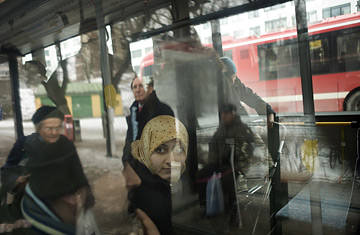
Ali Muhammed, 27, with his wife and daughter, on their way home from the immigration center in Stockholm, Sweden, on February 5, 2007. The family are refugees from Iraq.
(2 of 2)
But as is true around the world these days, the Iraqis in Sweden reserve their most bitter words for one another. As Iraq's ethnic fighting has intensified, so have the tensions among refugees living thousands of miles from the war. "Before, in Sweden, we never talked about who was who," says Salam Karam, an ethnic Kurdish journalist from Baghdad who moved to Stockholm with his family in 1990. "Now people talk about who's a Shi'ite, who's a former Baathist. Have they come here to hunt us?" He says he was shocked to find that when he taught Swedish to Iraqi refugees last year, "my Shi'ite students never spoke to those who were Sunnis."
The Swedish government has opted to grant refuge even to Iraqis who enter illegally rather than pursue them for using forged documents. "We don't turn anyone back," says Gunn Sundberg-Hjelm, an asylum officer at the Swedish Migration Board. "Look at the circumstances they have left." But how long can the warm welcome last? Swedish voters last September ousted the leftist government, largely over fears about growing unemployment and the country's costly welfare system. That nervousness may increasingly be directed at the new Iraqi refugees, who benefit hugely from Sweden's social services. The country has spent tens of millions of dollars on the new arrivals, who receive a daily allowance, housing and free health care. Beyond the burden to Sweden's economy, the influx could also pose a security risk, says Magnus Norell, senior analyst for the government-funded Swedish Defense Research Agency and a former Swedish Secret Service special analyst on terrorism. "It's not just that Iraqis are swamping the system," says Norell. "The government realizes that there are several people in this country who should not be here, people who would not get in because they have involvement with Islamist organizations in Iraq and Europe." With the numbers of Iraqi refugees soaring, the government doesn't "have time to do the proper investigation."
But for both the thousands of Iraqis who have found their way to Stockholm and the European hosts who have taken them in, there is no going back. Hunched over a borrowed computer in his small apartment, Alaa, the television producer, spends hours a day looking at digital photographs of his small son playing on his bed back in Iraq. Alaa hopes to get his Swedish residence papers sometime this year, allowing his wife and year-old boy to join him in Stockholm--two more Iraqis seeking escape from a world gone wrong.