

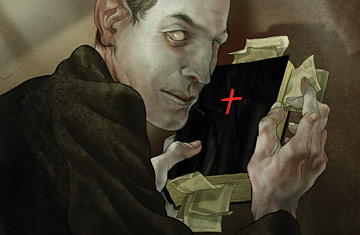
Illustration by Sam Weber
(2 of 3)
Just when the Catholic Church in the U.S. was beginning to recover from the sordid sexual-abuse scandal of 2002, it may be staring at a new crisis. "This is the last thing the church needs when you think how low its moral credibility already is" in the wake of the child-molestation tragedy, says Chuck Zech, director of the Center for the Study of Church Management at Villanova University in Pennsylvania. "But I'm appalled at the lack of internal [financial] controls at Catholic parishes." In a recent study co-authored by Zech and Villanova accountancy professor Robert West, 85% of the 78 U.S. Catholic dioceses responding to their survey (out of a total of 174 queried) reported embezzlement cases--and 11% had scandals of $500,000 or more. Some cases involve laypeople and not priests; and the study's one silver lining is its finding that priests are often the whistle-blowers.
Still, the increasing number of clergy getting caught with their hands in the offertory is once again prompting questions about the Catholic priesthood. Not that clerical enrichment is by any means an exclusively Catholic scourge: it's hard to forget that Protestant TV evangelist Jim Bakker once defrauded his followers of $158 million. But scholars like Zech argue that the financial apparatus at Protestant churches is often "more transparent and encouraging of lay participation" than it is at Catholic parishes--where, says Hamel, some pastors still carry "an Old World attitude that what's in the collection basket is theirs personally to do with as they wish."
Priestly arrogance may not be the only factor. Unlike monks, parish priests do not take a vow of poverty; but they promise to be celibate, which many assume blunts greed since they don't have families to support. Ironically, says one South Florida priest, many priests see the sacrifice of sex and family as a source of "entitlement--a reason parishioners should provide extra pin money for Father." What's more, priests can resent seeing how comparatively well their Episcopal or Jewish counterparts live--and the fact that Catholics in the U.S. give half the share of their income to their churches that Protestants do, according to the Center for Applied Research in the Apostolate at Georgetown University.
That's no excuse for pick-pocketing parishioners. But the issue underscores a changing social dynamic between priests and their flocks. In past generations, U.S. Catholics tended to be working-class, and priests often had comparatively cozy lifestyles. "Today," says Terry McKiernan, co-director of the watchdog site BishopAccountability.org "there's been a strange flip-flop." Parishioners are often middle or upper-middle class, while priests--whose median salary is about $35,000, including their free room and board--can be left with a nagging sense of diminished stature in our money-conscious society. Palm Beach is home to some of the nation's most affluent Catholics; but Skehan and Guinan were born in Ireland when it was still dirt poor. By most accounts, Skehan was a beloved pastor, yet one of his most telling remarks to police was that he felt he was "never properly paid."