

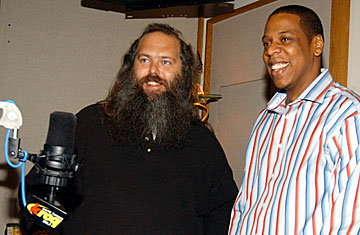
Rick Rubin and rapper Jay-Z in 2004
(3 of 4)
Rubin begins by telling artists that they won't be going to a recording studio, picking a release date or thinking about a single. "I try to get them in the mind-set that they're not writing music for an album," he says. "They're writing music because they're writers and that's what they do." Months and occasionally years can pass, which is why Rubin often has as many as four projects going at once. He almost never comments on individual lyrics, although he will protest if he thinks something is emotionally untrue. ("He's great at productive antagonism," says Chili Peppers' singer Anthony Kiedis.) Instead, he uses beach walks and quiet meals to get people to open up. "Writing is dull and unglamorous stuff," says Rubin. "For most people, it's really pretty miserable. But if you write 30 songs, there's a better chance that the 10 on your album will be better than if you just write 10."
By the time everyone decides that there's enough material to start recording, Rubin usually feels that the work is 90% done. "If a song is great on an acoustic guitar, you can make a hundred different versions of that song and it'll still be great," he says. While many producers came up as studio engineers, Rubin says, "I came up as a fan. I'm no expert at the technical aspects" of recordmaking. Kiedis, who has worked with Rubin on five albums, says, "He basically goes into the engineer's booth, removes everything in the room and has his people bring in the most comfortable couch-bed-type object that you'll ever see. Then he'll cover it with pillows and blankets, and that becomes his station."
Rubin listens intently from his cushioned perch and uses his lack of expertise to upend the traditional producer-as-God dynamic. "In the old days, when I'd hear something that's not working, I'd say, 'O.K., this is how we're going to fix it.' Now I ask, 'How do we fix it?' And nine times out of 10, what they come up with is as good as or better than how I would've done it," he says. Rubin's "they" includes a circle far wider than that of his peers. During a 1993 recording of an aborted Mick Jagger blues record, session guitarist Smokey Hormel recalls, Rubin walked up and asked, "How can I make guitars sound better?" "That was a first," says Hormel, who has since become a featured player on several Rubin albums. "He's still the only producer that does that. He runs a real democracy." Says Kiedis: "The truth of the matter is, we probably could have made this album without Rick, but why would we want to? It's just a better, more bitching experience when he's around."
Kiedis, Rock and other close Rubin friends (the circle changes and currently includes actor Owen Wilson and Borat director Larry Charles) are pressing Rubin to go to the Grammys and revel in his moment, but Rubin says, "I'm really not a celebrating-myself kind of guy. I'll probably spend the night at the studio, then come home and watch it on TiVo."