

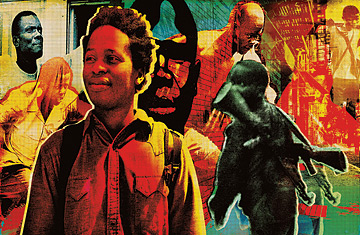
Ishmael Beah doesn't realize it, but he's about to become a rock star. Well, the literary-humanitarian equivalent of a rock star. (I'll eat my hat if he does not meet Bono in the next 12 months.) Beah, 26, slight and handsome with a ready but wary smile, has written a memoir, and it's a doozy. Separated from his parents at 12 when rebel soldiers attacked his Sierra Leonean village, by 13 he was a child soldier and a drug addict. By 19 he was living in the U.S., at Oberlin College, in Ohio. In February he's starting on a book tour.
Beah's book, A Long Way Gone (Farrar, Straus & Giroux; 229 pages), which comes out this month, is a breathtaking and unself-pitying account of how a gentle spirit survives a childhood from which all the innocence has suddenly been sucked out. It's a truly riveting memoir. But just as crucial to its success is its arrival at what might be called a cultural sweet spot for the African child soldier. The kid-at-arms has become a pop-cultural trope of late. He's in novels, movies, magazines and on TV, flaunting his Uzi like a giant foam hand at a baseball game. He's in the latest James Bond movie and The Last King of Scotland and is the key plot point of Blood Diamond. His American cousin was on the most recent season of HBO's The Wire. The Gorillaz have a song about him. The Onion.com has a parody.
Why the sudden prominence? As a symbol of a situation gone rancid, the weaponized child is nigh on irresistible. Aristotle would call him the essence of tragedy, a figure who inspires both pity and fear. Directors would call him a great scene setter. Even in an age when it's hard to get people to agree even on what they disagree about, nobody lobbies for sending children into battle, and the people who put them there serve as the kind of villains any storyteller would love. The first person the controversial International Criminal Court will try is a Congolese warlord accused of conscripting kids.
Hollywood, currently nursing a weapons-grade crush on Africa, has also turned its klieg lights on the plight of its children. Perhaps you heard about a couple of celebrities adopting kids from there? Fascination with the continent's woes dates back to Bob Geldof's famine-relief concerts in the mid-'80s. Bono picked up the baton in the '90s, and now every African nation seems to have its own celebrity benefactor. George Clooney has made the situation in Darfur one of his key talking points. Madonna is building an orphan center in Malawi. Brad Pitt helped produce and Nicole Kidman narrates God Grew Tired of Us, a documentary currently in cinemas about the Lost Boys of Sudan. It follows the lives of youngsters who, separated from their parents, banded together and walked more than a thousand miles to escape the civil war. As some of them eventually are resettled in the U.S., they face a whole new set of challenges (including escalators and freezers).