

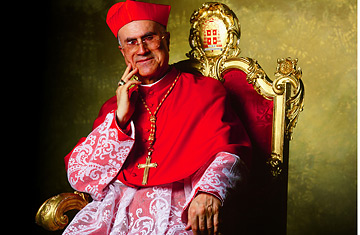
Cardinal Tarcisio Bertone
Cardinal Tarcisio Bertone doesn't have the guarded air of those who tend to rise to the heights of Vatican power. He smiles easily. He laughs out loud. His oval face and dark, bespectacled eyes show no sign of scars from the bureaucratic battles that accompany most climbs up the Roman Curia career ladder. A few years ago, I saw Bertone walking alone on a side street near St. Peter's and went over to say hello and shake his hand. He stopped on a dime when he heard his name, turning toward me with his arms spread open, and practically sang out in his baritone, "Oooh! Carissimo! How's it going!?" And we had never even met before.
Such gregariousness has apparently helped the 72-year-old find friends in high places. Bertone, a native of the northern Italian region of Piedmont and a former theology professor, worked for seven years as deputy for then Cardinal Joseph Ratzinger in the Congregation for the Doctrine of the Faith, the office that oversees church orthodoxy. Promoted in 2002 to Archbishop of Genoa, Bertone attained the rank of Cardinal the next year and was thought to be among the core group in the conclave that pushed for Ratzinger's election. Still, since he didn't have the usual résumé from the Vatican diplomatic corps, many were surprised when his old boss, now Pope Benedict XVI, tapped him to take over in September as Vatican Secretary of State, the No. 2 slot in the entire Catholic Church hierarchy, behind only the Pope himself.
Bertone sat down last week with TIME for a rare interview in the sunny 15th century Vatican tower that serves as his temporary office while the Secretary of State's quarters are being remodeled. "The Holy Father has shown to have great trust in me," Bertone says, recalling their years at the doctrinal office. "We were the consummate duo. We've always gotten along personally, and there is a mutual understanding that continues to be the basis for our work together." It's the kind of affinity--similar to what U.S. Secretary of State Condoleezza Rice is said to have with President George W. Bush--that inevitably adds extra weight to an already influential assignment.
Although he shares the same title as the chief U.S. diplomat, the Vatican Secretary of State is more like a Prime Minister, responsible not only for foreign policy but also for overseeing church headquarters at the Roman Curia, being the Vatican link to Catholic organizations and officials around the world, and even stepping in for the Pope if he falls ill or is unavailable. While Pope John Paul II's constant travels kept him somewhat separated from the workings of the Vatican bureaucracy, Benedict and Bertone are instead expected to work hand in hand on all matters, foreign and domestic. The Pope will need his No. 2 as both a political strategist and a sort of chief of operations, which will give Benedict the space to pursue the intellectual and theological aspects of the job that he prefers. Moreover, if Benedict hopes to continue streamlining the governance of the church--which would include interrupting the ambitions of top prelates--he will have to lean on Bertone, who handled such delicate tasks in the past as spearheading Vatican negotiations with the ultratraditionalist Lefebrve group. "The Pope can count on Bertone's absolute loyalty," says a veteran Vatican diplomat. "Ideally, the Secretary of State must maintain some autonomy while always reflecting the thoughts of the Pope."