

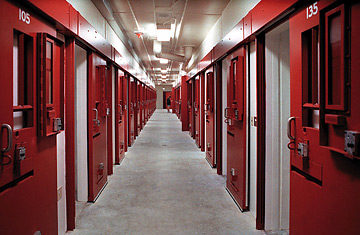
A SuperMax prison in Boscobel, Wisconsin.
(2 of 2)
Modern science has confirmed this, with electroencephalograms showing that after a few days in solitary, prisoners' brain waves shift toward a pattern characteristic of stupor and delirium. When sensory deprivation is added--as when Padilla was seen being led from his cell wearing a blindfold and sound-deadening earphones--the breakdown is even worse. As long ago as 1952, studies at Montreal's McGill University showed that when researchers eliminate sight, sound and, with the use of padded gloves, tactile stimulation, subjects can descend into a hallucinatory state in as little as 48 hours.
All of this is providing legal traction for constitutional lawyers. The most obvious point of attack is the Eighth Amendment's ban on cruel and unusual punishment. One suit involving prisoners in a Wisconsin supermax has led to rulings requiring that mentally ill inmates be kept out of such facilities. The state is challenging the decisions, and arguments will be heard in February, but at least six other states have fought similar suits, and all of them have failed. "So far, the prisoners are batting a thousand on the issue of mentally ill inmates," says David Fathi, a senior staff counsel with the A.C.L.U.
Another approach--one that's a bit of a constitutional bank shot--is to rely on the 14th Amendment's requirement of a due-process hearing before the state denies an inmate a "liberty interest," something courts define as a reasonable expectation of a freedom or right. People confined to prison have few liberty interests left and thus have little ground to challenge assignment to a strict level of security. Confinement to supermax, however, may be so qualitatively different that it does require a hearing. That's the argument Ohio inmates made in 2005, and that's the argument a unanimous Supreme Court bought, with Justice Anthony Kennedy writing that supermax isolation imposes such an "atypical and significant hardship" that prisoners must have a formal opportunity to make their case against the assignment before prison officials decide.
The eventual ruling on Padilla's fitness could liberalize things further, and similar suits are sure to follow. Even so, no one thinks the supermax system is going away soon. For all the debate the prisons generate, it may not take much to make them more palatable to civil libertarians. TVs or radios, reading material and clocks, as well as a bit of natural lighting--which provides critical time-of-day orientation--would help stabilize inmates. So would human contact with guards or other prisoners.
"Just how sterile do you have to make that cell?" asks retired prison expert Chase Riveland, who spent his career as an official in the Colorado, Wisconsin and Washington prison systems.
What's more, inmates aren't the only ones hurt by extreme incarceration. People like Padilla or the Guantánamo Bay detainees are, in theory, resources for information about the extremist groups with which they are putatively associated. "To an overwhelming degree, such people are not threats behind bars. They're opportunities," says Grassian. "We hurt ourselves by destroying their sanity." Closer to home, prisoners serving sentences for more mundane crimes do sometimes get released. Demolish their psyches while they're in prison, and nobody's safer when they get out.
Part of the reason we build prisons at all has always been the retributive urge. Those who do very bad things while they walk among us should lead very hard lives after they have been removed. That makes a lot of emotional sense. Whether it always makes practical sense is something else entirely.