

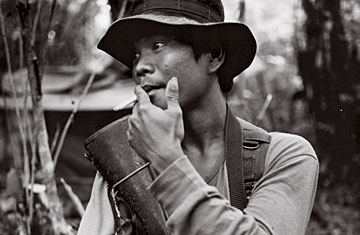
A fighter in the New People's Army, which has waged war in the Philippines for over 30 years
(2 of 3)
At the town of San Francisco—a dreary, concrete facsimile of its famous namesake—we are picked up by two N.P.A. men in jeans and T shirts in a four-wheel drive with darkened windows, then speed out of town along potholed logging tracks. As we leave the highway far behind, the villages grow visibly poorer; a rare stretch of paved road is announced by a sign bearing the President's face and the slogan GLORIA CARES. In many villages, government troops are dug in behind sandbags and razor wire. Three hours later, we transfer to trail bikes and roar along deserted tracks to a semi-derelict logging shack. Waiting there are five N.P.A. soldiers with M-16s, who guide us through the darkening jungle to a camp lit by flickering oil lamps. "The comrades are very excited you're here," says a voice from the gloom.
The voice belongs to Comrade Victor, 39, the political officer assigned to look after us. (Victor, like all N.P.A. fighters, uses a nom de guerre. The platoon's machine gunner is called Comrade Bren.) A handsome man dressed in shin-length shorts and orange flip-flops, Victor first apologizes for his poor English (he speaks it perfectly), then for our circuitous journey: a rebel operation had caused more "bad weather" to the south. "Our people were carrying out a punitive action," says Victor, meaning an assassination by an N.P.A. "sparrow unit" or death squad. The man killed was a farmer, he explains, but his role as a police informer had earned him "a blood debt against the revolutionary movement."
About a fifth of N.P.A. fighters are under 18, according to Jane's Information Group, an authority on defense and terrorism. Most of this 30-strong platoon are too young to recall the purges and, despite embracing communal life, have often joined the rebels for personal, rather than political, reasons. Many are high-school dropouts with no job prospects, impressionable youths whom the N.P.A. recruits and molds into loyal killers for the communist cause. For Joven, 21, joining meant personal salvation. "I had a different lifestyle before," he says. "I was addicted to marijuana and alcohol. I hung out with a neighborhood gang." Joven was shot during an offensive four months ago and the bullet rests painfully under his spine. But he says, "I'm happy with the comrades. Even though we come from different neighborhoods, from different classes, we fight as one."
By the often lethargic standards of troops fighting long-running jungle wars, this N.P.A. platoon seems hyperactive. At 4 a.m., hours before daybreak, its soldiers are performing drills and martial arts in flip-flops and bare feet, then practicing grenade throwing with rocks from a nearby river. Their entire week is plotted out: from Monday to Friday, there's military and medical training, plus basic education and indoctrination sessions; weekends are devoted to food production and cultural activities. Even off duty, the platoon stays on message, gathering around a guitar to sing rebel songs or—possibly for the benefit of the platoon's foreign guests—the N.P.A.'s own anthem: "The New People's Army is not the army of the rich/ Which follows the orders of the greedy/ Awakened, we freely join the People's Army/ We offer our lives to the poor."
There are few other diversions. The newspapers I bring are read and reread, then torn into strips to use as cigarette papers. Alcohol is banned and food is scarce. For two days there is gristly pork—a treat for the guests—and afterwards only tiny salted fish or lentil gruel. When the Philippine army blocks supply routes, the rebels hunt the depleted forests for wild pigs, monkeys, snakes and beetle grubs.
"There are no ranks in the N.P.A.," Victor tells me, "only responsibilities." But experience makes some comrades more equal than others. Platoon leader Jorex, 41, is a brooding giant with a bandolier of grenades strung across his chest. As a youth, he was recruited by a government militia to fight the N.P.A. but instead defected to the rebels.
A personal tragedy—the 1993 death of his brother, also an N.P.A. guerrilla, in a firefight with government troops—reaffirmed his commitment to the cause. "He died in my arms," says Jorex. "It was painful. But I feel the same pain when one of my comrades dies."
Jorex and his wife Wendy, 33, have five children aged 3 to 12, who live in Mindanao with relatives. They see the children twice a year, surreptitiously, to avoid detection by the authorities. An N.P.A. fighter for 15 years, Wendy is tormented by the idea that her children are vulnerable. "Sometimes it terrifies me to think what the soldiers might do to them," she says. Wendy claims that the military has taken photos of the house where they live, and that on one occasion a government soldier interrupted an N.P.A. radio communication to announce: "If you kill our colleagues, we'll kill your children." Executive Secretary Ermita says the accusation that the military would threaten or target children "is pure N.P.A. propaganda. If that really happened, the commanding officer would have known and we would have known. The soldier would have been punished."