

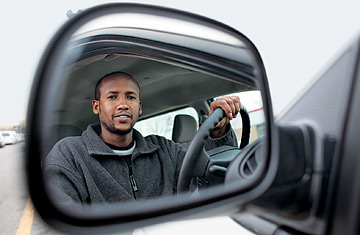
Rasheed Gardaad, 29, a cab driver for the past five years, waits in a line at an airport in Minnesota, where Muslim cab drivers don't want to carry alcohol in their cars.
Even in religion, where the most insignificant act has cosmic implications, there are big stories and little stories. When an image of Mother Teresa turns up on a cruller, the call is easy. But when a disturbance occurs in the fraught, supersaturated relations between Muslims and non-Muslims, elephantiasis may occur. Witness the tale of Minnesota's Muslim cabbies.
Starting in 2000, some of the 600-plus Somali Muslims who make up three-quarters of the fleet serving Minneapolis--St. Paul International Airport stopped picking up passengers who were carrying duty-free liquor boxes or other obvious signs of booze, returning to the end of the cab line rather than disobey the Prophet Muhammad's ban on bearing alcohol. Their Islamic jurisprudence might actually have been a little shaky: most varieties of Islam hold that while Muslims in a non-Muslim country may not drink alcohol, they may carry it, something cabbies in most American cities do without a qualm. Still, by last year the total number of refusals topped 5,000, with as many as 77 a month. Passengers spoke of being rebuffed by several cabs in a row. So the airport reached out to the drivers, and along with the local chapter of the Muslim American Society (MAS), came up with a seemingly ingenious solution: equip alcohol-bearing cabs with a roof light in one color, dry cars with another, and have dispatchers steer passengers accordingly.
That's when the matter began to take on a larger significance. Word got out, talk radio blabbed, and "at one point," says airport spokesman Patrick Hogan, "we were getting a [negative] e-mail every 90 seconds." Some were vile. Others posed good questions: What would keep dozens of other religious groups from demanding their own preferences, with chaos ensuing? Finally there was the full-dress clash-of-civilizations argument, spun by professional anti-Muslim watchdogs like Daniel Pipes, director of the Middle East Forum. The hacks' demands, he wrote, posed "potentially major implications for the future of Islam in the United States." Danish TV showed up. Al-Jazeera did a live feed.
The airport brass retreated. This month it called for a 30-day airport-license suspension for first-time nonpickups and two years for the second instance. Late last week, Hassan Mohamud, the MAS representative, was still talking feverishly about finding what he called "an alternative within both systems--the one they believe and the one they are living with."
That may be tough. Immigrants to the U.S., and others, often think freedom of religion is absolute, but it is balanced against other rights or commercial concerns, and the Civil Rights Act of 1964 states that "reasonable accommodation" of faith can be trumped by "undue hardship" to an employer. Courts have denied Muslims time off for Friday prayers during business hours. A Roman Catholic pharmacist lost his lawsuit last year against Wal-Mart, which fired him after he refused to fill or transfer orders for birth-control pills.
The Twin Cities taxi issue is thus a rite of passage for both the Muslim community and its neighbors. The cabbies may be wrong, but it takes a special sort of paranoia to turn their action into the kind of constitutional threat that caused Pipes, when he heard the airport's new stance, to trumpet NO ISLAMIC LAW IN MINNESOTA.