

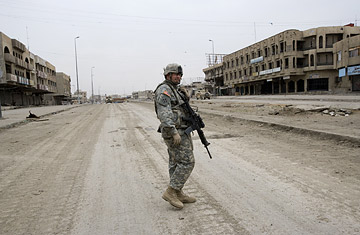
The smoke rose above Baghdad in plumes of thick, black soot, carrying with it the ashes of a dying regime. The nights were full of fire and noise, as thousands of Tomahawk missiles and smart bombs crashed into their targets, sending up balloons of searing orange flame into the night sky. In the light of day, calm descended on the city's streets, and the silence was pierced only by the crackle of burning buildings and the wail of emergency sirens. Iraqi officials angrily prevented reporters from venturing near the scenes of destruction, but word spread quickly among the hardened citizens of the city what exactly had been destroyed. Three days into the American war on Saddam Hussein, the soaring government buildings and opulent palaces that once stood on the banks of the Tigris River were gone. Even if Saddam and his most trusted aides somehow managed to survive a bombing campaign expressly designed to kill them, their tyranny appeared ready to crumble with the foundations of their fortresses. It seemed to be only a matter of time.
But wars move according to their own tempo; war plans, military men often say, are made to bebroken, good only until the first bombs are dropped and the real fighting begins. At the White House and inside the allied war rooms, the mood swung from hopeful expectation, with signs that the Iraqi regime may have been decapitated, to admonishing sobriety on Saturday, as U.S. soldiers encountered significant enemy fire outside southern Iraqi cities and on the road to Baghdad. "There's no cheering or high-fiving whatsoever," said a senior White House aide. "This is not a cakewalk." By the end of last week, Pentagon officials said they were pleased with the pace of the campaign, as U.S. forces pushed more than 150 miles into Iraq, but there was also plenty of anxiety about the hazards that might still lie in wait — perhaps only days away — as the steel wave of allied power pushed toward the gates of the capital. "Things are going pretty well," a senior Pentagon official says. "Perhaps too well."
The opening act of Gulf War II did not proceed according to the Pentagon's carefully scripted blueprint — to begin the attack with a rapid push of ground troops, followed by a massive air assault designed to "shock and awe" the enemy into submission. That plan was pre-empted because of an intelligence bonanza that could have delivered the knockout punch before the opening bell. Acting on fresh information that came in hours before the deadline the U.S. President had set for Saddam to give up power, George W. Bush ordered U.S. forces to strike the Baghdad bunker where Saddam was believed to be sleeping. Just before dawn Thursday, three dozen Tomahawk missiles outfitted with 1,000-lb. warheads were unleashed from six warships in the Persian Gulf and Red Sea and slammed into three buildings in Baghdad. "The intelligence indicated there would be senior Iraqi leadership at all three," a Pentagon official said, "but one target was more important than the other two." Shortly after the missiles found their marks, a pair of U.S. F117 fighters dropped four 2,000-lb. bunker-busting bombs on an underground facility believed to be housing Saddam and at least one of his two ruthless sons Qusay and Uday.