

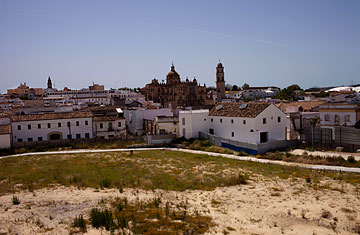
Abandoned dream This choice lot in central Jerez was supposed to be the site of a cultural center called Flamenco City, but it was never built
(2 of 3)
Nowhere are the effects of these problems more evident than in the southern city of Jerez de la Frontera. With its flamenco and its sherry, its whitewashed houses and flowering balconies, Jerez is that most Spanish of cities, a guitar-strumming, dark-eyed Andalusian fantasy. But these days, it embodies Spain's markedly less romantic side. With 211,000 inhabitants and €1 billion in municipal debt, according to local government sources, it is, per capita, the most indebted city in the country. In absolute terms, only Madrid, with a population of 3.3 million, owes more. Its bills go unpaid, its public services are disappearing, and unemployment in the province is mainland Spain's highest. The municipal government, also controlled by Rajoy's Popular Party, has responded by drastically slashing its expenses and freely admits it cannot begin to think about restoring growth until it has managed to chip away at the monumental debt. "We are a beautiful city with lots to offer, but these days what we're primarily known for is the crisis," says David Fernández, editor of the local newspaper Diario de Jerez. "Jerez is the vanguard of disaster."
Vanguard and portent. Economic decline in the city began earlier than in the rest of Spain, when the area's critical wine industry began to flag in the late 1990s. Yet for years the impact of that decline was masked by Spain's boom, and revenues lost from one departing industry were replaced with the country's favorite panacea: construction. As it did everywhere in Spain, municipal spending grew — and city payrolls with it. When the Popular Party took power in June 2011, it discovered not only that the local government was €1 billion in debt but also that it was going to remain in debt for a very long time. "There was no liquidity," says Antonio Saldaña, deputy mayor and city spokesman. "The previous government had racked up debts that would consume all our income until the year 2023."
Hence the drastic measures. Citing a bloated payroll — Jerez's town hall currently employs 1,900 people directly and another 600 indirectly — Mayor María José García-Pelayo announced plans at the end of March to cut 390 jobs. She has not paid direct municipal employees in nearly three months; indirect ones — people who work for companies contracted by the city — have not been paid in five. And once city hall catches up on its back payments, salary freezes and early retirement are on the horizon for many public employees. Inma Sánchez (no relation to Marisa) is one of them. A home health care worker, she helps man the makeshift tent festooned with angry banners that she and her colleagues erected as a permanent protest outside city hall after they stopped getting paid. The rest of the time, a sense of responsibility compels her to show up for work. "I take care of people who are confined to their beds," she says. "We give them medication, we bathe and feed them. If we don't go to work, they don't survive. How could we possibly quit?"
Sánchez, who protests in her scant spare time, is living on fumes. With no paycheck since January, she relies on the €400 she receives in alimony for her two daughters, on her credit cards and on a one-year reduction in her mortgage payments that she negotiated with her bank. When the big spring fair launched recently, she took a job at one of the bars in the hope that the extra money would buy her and her family another month or so. "And that's it, my whole survival plan," she says. "I don't know where this ends."
No one in Jerez does, which is why the sense of desperation worsens by the day. Schools have closed for weeks at a time because there has been no one to clean them. Street lighting has gone out repeatedly because municipal electric bills went unpaid. Only the main branch of the library has electricity, so any studying has to happen during daylight hours. Cáritas, the church-run Catholic charity, has seen attendance in its job-training programs and at its soup kitchen skyrocket. "It's been brutal," says director Francisco Domouso. "And what you notice is that the growth all comes from a level of society that never before was associated with taking charity."
Add to those woes an almost complete collapse of public transportation. Until May 11, Jerez's urban bus drivers had been on strike for 13 weeks because the company they work for suspended payments and its administrators left the city. Labor agreements were supposed to guarantee at least 19 buses circulating each day (down from the 60 that normally run), but with no one around to pay for the supplies necessary for maintenance — let alone the mechanics — even those few were frequently out of service. It was only recently, when the city moved to assume control of the buses from the subcontractor, Urbanos Amarillos, that service resumed.