

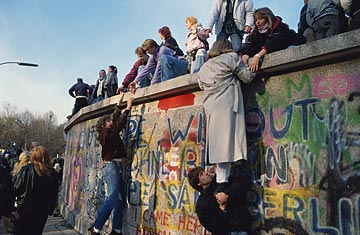
Crowds bear witness to the fall of the Berlin Wall on Nov. 10, 1989
(2 of 2)
But despite his abhorrence for the Wall and the totalitarian system it symbolized, Reagan was even more mindful of the consequences of military confrontation with the Soviets. "A nuclear war cannot be won and must never be fought," he said in 1983. During the early years of his presidency, Reagan privately sought to open dialogue with the leaders of the U.S.S.R. but made no headway. With Gorbachev's arrival in 1985, Reagan found a partner who could help in his quest to end the arms race--and ultimately abolish nuclear weapons. "There was something likable about Gorbachev," Reagan said after their first meeting in Geneva.
By the time Reagan went to Berlin in 1987, he and Gorbachev had developed enough trust to gamble on change. In the weeks leading up to the speech, several Administration officials lobbied to have the "tear down this Wall" line removed, arguing that it was unrealistic, unpresidential and potentially embarrassing to Gorbachev. But Reagan and his speechwriters insisted on keeping it in. To the President, the line was an invitation as much as a challenge: calling on Gorbachev to tear down the Wall might actually inspire him to do it. "If he took down the Wall," Reagan told an aide after returning from Berlin, "he'd win the Nobel Prize."
Reagan was right. (In 1990, Gorbachev not only won the Nobel but was named TIME's Man of the Decade.) Neither Gorbachev nor Reagan was directly responsible for the fall of the Wall; rather, it collapsed from its own weight. But Reagan's speech presciently identified Berlin as the proving ground of Gorbachev's intentions to open up the communist bloc. If Gorbachev truly sought peace and liberalization, Reagan said in Berlin, then he should let the Wall come down. In the end, Gorbachev did, and the rest of the Iron Curtain followed. Allowing democracy to spread through Eastern Europe in 1989 was Gorbachev's greatest accomplishment; in this drama, Reagan was the supporting actor. Nevertheless, as Sean Wilentz, a liberal historian, wrote in 2008, Reagan's "success in helping to finally end the Cold War is one of the greatest achievements by any President of the United States--and arguably the greatest single achievement since 1945."
What lessons can the current President learn from that achievement? Even if Barack Obama tries to make peace with the mullahs of Iran or with insurgents in Afghanistan, as Reagan did with the U.S.S.R., there's no guarantee he'll succeed. The threats facing America cannot be willed away. Defusing them will ultimately require the mix of firm resolve and patient diplomacy practiced by successful American statesmen throughout the Cold War. Reagan's gift was his ability to speak candidly about the realities of the age while still presenting, and working toward, an optimistic vision of the future. He sensed when the right risk might be rewarded. Obama's challenge now is to do the same.
This article is adapted from Ratnesar's book Tear Down This Wall: A City, a President, and the Speech That Ended the Cold War