

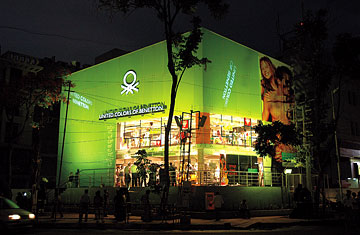
Green for go
In the first half of the year, Benetton opened 95 new India outlets, including this Bangalore store, as part of an international expansion push
Mention the name Benetton to people over the age of 35, and chances are they'll remember shelves filled with brightly colored knitwear and, just as likely, some of the controversies over the brand's provocative advertising campaigns in the 1980s and '90s.
In fashion terms, that was light-years ago. These days, upstart brands such as Zara and H&M are stealing the headlines — and the allegiance of many younger shoppers — as they storm the world from Moscow to Manila. But Benetton, which had sales last year of about $3 billion, hasn't gone away. The ads for its United Colors of Benetton stores are tamer and its growth less stellar, but even in middle age — the brand turned 43 this year — Benetton is proving itself to be a case study in business management. For behind the scenes, without fanfare, the four Benetton siblings, who started out in the 1950s making sweaters on their kitchen table with a borrowed knitting machine, have been engineering what is perhaps the hardest task facing any successful family business: passing the torch to the next generation.
Luciano, Carlo, Gilberto and their sister Giuliana Benetton several years ago handed over day-to-day operations of Benetton Group, the apparel company they built from scratch, to professional nonfamily managers. Earlier this year, they went a big step further, by putting the finishing touches to a family-ownership structure that divides their combined assets into four equal sets of shareholdings. This new structure clearly indicates the lines of succession and lays down rules for family members who may in the future want to divest. Four of the 14 children, one per founding sibling, are now on the board of the family holding company, which is called Edizione. Only one of them is in an operational role: Alessandro Benetton, 45, the eldest son of Luciano, himself the eldest of the founders. For the past two years Alessandro has served as Benetton Group's executive vice chairman, overseeing top management and strategy.
Putting Alessandro at the helm of the family's original business wasn't some dynastic reflex: he had to earn it. A graduate of Harvard Business School who spent several years at Goldman Sachs, he founded and grew a private-equity firm specializing in midsize Italian companies; its holdings currently total about $1.4 billion. Ending up at the family firm "was completely unexpected," he tells TIME in a rare interview. As a young man, there was never pressure on him to get involved; the unwritten rule was only that whatever he did, he should do it well. "Implicitly, we would live our own lives," he says. "If I went down the road and saw a Benetton store, it wasn't like I would say, Oh, that's mine. It was more like, Let's see if the windows are clean."
Generational shifts in family businesses are notoriously tricky. A rule of thumb is that only 1 in 3 family firms survives the transition from the founding generation to the next, and only 1 in 10 makes the jump successfully from the second to the third generation. The more numerous and distant the cousins involved, the harder the task of keeping them all in line — although sometimes the biggest problems come from the closest relatives. In India, brothers Mukesh and Anil Ambani, who split their father's business empire, have made headlines for months with their sibling rivalry. In Germany, one of the most contentious business stories of the past year involved a feud between the two branches of the family that owns Porsche.
In the northern Italian town of Ponzano where Benetton is based, near Treviso and a half-hour drive from Venice, discussion of the family and the roles played by individual members is treated with great delicacy. Executives there stress that even though Alessandro is the most prominent of the next generation, no decision has been made about which of the cousins will end up running the entire family holdings. For now, that's still Gilberto's role. He was the finance man of the founding generation, which worked brilliantly together as a team. Giuliana was responsible for the clothes, Carlo was in charge of production and Luciano, who posed naked in one ad, was the company's highly public face.
As they grew rich on sweaters, the founders deliberately didn't stick to their knitting but diversified. Benetton Group now accounts for less than one-quarter of the family's corporate empire, which had sales exceeding $16 billion last year. The rest is made up of a clutch of different businesses. Buy a sandwich at the Empire State Building in New York City or Bangalore's new international airport, and a catering company called Autogrill that is 59% owned by the family will serve it up. In Italy, their holdings include stakes in the main business newspaper, the Pirelli tire company, Florence airport, an investment bank and the firm that manages the nation's 13 biggest railroad stations. Another major asset is the highway-construction and management company Autostrade, which runs more than 2,100 miles (3,400 km) of toll roads, including the Italian half of the Mont Blanc Tunnel. Some of the investments have done very well; others have tanked. The family lost several hundred million dollars with an ill-timed investment in Telecom Italia at the height of the Internet bubble. Another costly mistake was the acquisition of several sporting-goods companies, including Prince tennis rackets and Nordica ski gear, which have since been sold.