
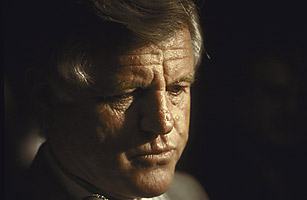
Senator Edward Kennedy
When I first met Ted Kennedy 55 years ago, he did not initially seem to be much more than the "kid brother" — fun, funny, friendly, but not a major part of the genial Kennedy dinner-table conversations on policy and politics. When I last met with him, in the summer of 2008, he was the Senate's next-to-eldest statesman convening a breakfast meeting to discuss his plan to establish a research institute or foundation for the scholarly study of the Senate and its role and history in American public life. I took that opportunity to present to him a copy of my new book of memoirs, Counselor: A Life at the Edge of History, with a personal inscription commending him on his accomplishments and predicting more in an even brighter future. In a few days, he graciously replied to my letter and closed with a prediction that an Obama victory would implement my ideals.
Going from "kid brother" to senior statesman was an extraordinary journey for Ted Kennedy, matching the similar journeys taken by his brothers John and Robert. All three of the Kennedy brothers who entered our national public life — meaning the three who survived World War II — demonstrated this extraordinary quality of growth, particularly after they arrived in Washington. Too many successful politicians stop growing once they reach there, certain that they already know it all and have completed their growth within the biblical standard of "wisdom and stature, and in favor with God and Man." But not the Kennedys, and certainly not Edward Moore Kennedy. A Harvard education, a University of Virginia law degree, a stint as an assistant district attorney in Boston, a key role in managing Jack's Senate re-election campaign in 1958 and equally key assignments in JFK's successful contest for the Democratic presidential nomination in 1960 and successful race to win the presidency — all contributed to Ted's rise in the esteem of his brothers and their respective staff, including me. Through each of those phases, "Teddy" was growing, maturing, developing, learning and gaining new experience and insights.
Spurred by his father and by his own interests to seek the Senate seat for Massachusetts that JFK had vacated upon entering the White House, Teddy entered a hotly contested Democratic primary in 1962. He was opposed — to President Kennedy's consternation — by Eddie McCormack, the favorite nephew of House Democratic majority leader John McCormack of South Boston. President Kennedy, whose brother Bob was then serving as U.S. Attorney General, was concerned that he would be accused of fostering nepotism and founding a dynasty. He did not wish to add a feud with Eddie's uncle to his already difficult relations with Congress. Nor did he wish to add yet another private disagreement with his beloved father to an already long list. So he publicly vowed that the White House would remain neutral regarding the 1962 Senate Democratic nomination in Massachusetts. But privately he asked RFK and me to fly unannounced to Cape Cod and brief Teddy on the eve of his first televised debate with young McCormack. We did so, in a dining-table session not unlike those I held with JFK to brief him before his first televised debate with Nixon and later to prep him for his biweekly press conferences as President. We found Teddy surprisingly relaxed and informed. He won the debate, the primary and the election, just as he won every race for re-election in the next 47 years.
The pride and joy that all three brothers felt in serving high national office at the same time was cut short by their father's stroke in 1961 and by Jack's assassination in November 1963. Through the difficult years that followed, Teddy's growth continued. Both a plane crash in Massachusetts in 1964 and the ugly automobile accident on Chappaquiddick Island in 1969 almost cost him his life, and the Chappaquiddick incident ultimately ended his bright prospects for still higher office.
And yet Teddy never lost his drive to serve his country and honor his brothers' memory. Bobby's assassination left Teddy in charge of not only the Kennedy legacy, but also the Kennedy family. Already a loving father of his own wonderful children, he took special care to help guide and comfort Jack's and Bobby's survivors.
Throughout it all, his impact as a Senator and a Democratic Party leader continued. He worked well with friends across the aisle, whether the Democrats were in the minority or majority, building relationships with Presidents of both parties, including LBJ (when RFK did not) and Carter (who did not reciprocate). Fellow Senators on more than one occasion have told me that when Ted rose on the Senate floor to speak, members of both parties paid attention whether or not their views were compatible with his, because they knew he had done his homework. He gained a reputation for first-rate staffers, and I can testify to their uniform excellence, including those in his Senate office and on the Senate Judiciary Committee. One example of the latter was Stephen Breyer, now a Justice of the Supreme Court. For years, Ted's aides on media relations, speechwriting and other key assignments continued to love and serve him, and that low turnover guaranteed continued excellence.
He initially focused on domestic policies of particular importance to RFK, including health care, civil rights, immigration, education and other key issues. Always an internationalist who favored legal and diplomatic solutions supported by our allies to resolve global conflicts, he became in later years particularly outspoken against the war in Iraq. He did not shy away from taking the lead on controversial issues in the Senate, even those that were sensitive back home in Massachusetts — including school busing, women's reproductive rights and judicial nominations.
Having sat by his bedside to see him come back from both his near fatal plane crash and automobile accident, I had hoped he would last another generation, dying at some dramatic moment on the Senate floor that he loved.
Several decades ago, John F. Kennedy, as a Senator known for his special interest in history — including the history of the Senate itself — was named to head a special committee to select five Senators whose portraits would hang in the Senate reception room for all to see. "The Famous Five" were to be chosen on the basis of their historic contributions in terms of courage, integrity and substantive activity over a long Senate career. They are now called "the Famous Nine," after two Senate resolutions added four more portraits. There are still two spaces remaining in that room. I can think of no one more deserving of having his portrait placed there now than Senator Edward M. Kennedy.
Sorensen was formerly the special counsel and adviser to President John F. Kennedy and is the author of Counselor: A Life at the Edge of History.