
Quotes of the Day


 TIME.com: What concerns of the Conclave might have prompted the choice of Joseph Cardinal Ratzinger as Pope Benedict XVI?
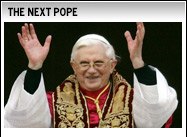
David Van Biema: The choice reflects a number of things: A desire for continuity with the papacy of John Paul II, which the cardinals believe — correctly or incorrectly — that Ratzinger best represents, having been more intimately involved with the last papacy than anybody expect John Paul II himself. As the head of the Congregation for the Doctrine of the Faith, he was John Paul II's theological enforcer for almost a quarter century. A second consideration would probably be that Ratzinger was almost universally acknowledged as one of only a handful of cardinals possessing the gravitas to take on the papacy. His intellect, his piety, his grasp of what the Church is all about and his willingness to grapple with the issues that face it were probably as great, if not greater than anyone else in that room. It takes a certain sort of person, in the eyes of the cardinals, to combine the qualities needed to make a good pope. And Cardinal Ratzinger represented one of a few who they already knew, without extensive investigation, possessed those qualities, and was able conceptually, intellectually and spiritually to take on the job.
 |
||||
 |
|
POPE BENEDICT XVI Assessing the New Pope Photos: The New Pope TIME 100: Cardinal Ratzinger Send Us Your Thoughts The Next Pope (Jan. 2005) TIME on Ratzinger (1993) The New Papal Job Specs Assessing the New Pope Photos: The New Pope TIME 100: Cardinal Ratzinger Send Us Your Thoughts The Next Pope (Jan. 2005) TIME on Ratzinger (1993) The New Papal Job Specs |
|
|
|
|
|
|
|
 |
||||
|
|
Web Exclusive | |
|
|
|
Daily reports from the scene in Vatican City The New Bishop of Rome Ratzinger Gets a Cold Top 10 Papal Candidates The Conclave's Length Cardinals Do Lunch Chasing Italian Cardinals Reading the Silence The Return of Cardinal Law |
|
|
|
|
|
|
|
 |
||||
|
|
Learn more about the Papacy in the TIME Archive TIME Covers: Popes TIME Archive Home Collection: John Paul II Commemorative Reprint Digital Magazine: 1978 |
|
|
|
||||
TIME.com: Could it be said that choosing a figure from within the Curia, known primarily as a strict and vigorous enforcer of doctrinal positions, may reflect a greater concern with managing the Church's bureaucracy and doctrinal issues among the clergy than with the sort of pastoral role played among the Catholic faithful by John Paul II?
DVB: By virtue of his central and high profile role in the previous papacy, we certainly know more about Benedict XVI than about many of the people who might have gotten the job. If there is a question mark over what he may do in the course of his own papacy, it probably has to do with the question if he'll act in a different way as pope than as head of the Congregation for the Doctrine of the Faith, which used to be called the Office of the Inquisition. It is not pastoral by nature. It deals with possible heresies, which requires an approach very different from that of a pastor dealing with his flock. There were two sides to John Paul II: his doctrinally conservative side, and his pastorally brilliant side. That enabled him to communicate effectively with his flock and garner a certain sympathy even when announcing a teaching that some of them disagreed with. It was one of his great gifts to be able to maintain a connection even with many of the people of his Church who disagreed with him. And that pastoral brilliance softened his conservative legacy within the Church. So the question becomes, is Benedict XVI capable of developing a pastoral side that could similarly soften the impact of his doctrinal side, which has been prominent for so long?
Managing the Curia, the Church's bureaucracy, is a separate question, and it may be as open-ended as the one about how good a pastor Benedict will be. It's less important to the non-Catholic on the street, but it's extremely important to the Church. Ratzinger was a master of the Curia, and used it as well as anybody. At the same time, he's reportedly of a non-bureaucratic cast of mind, and prefers to be as direct as possible in getting things done. That may prompt him to streamline the Curia. There's certainly some anticipation that he'll shake things up.
A related question is how centralized the Church will become, and whether any authority will devolve back to the Bishops. Benedict's papacy will pour cold water on the hopes of those who saw Vatican II as opening up the Church on questions of distribution of authority and autonomy, either to the residential bishops or to the laity. Most of the great debates of the past half-century in the Catholic Church have been about how to interpret Vatican II. Many Catholics in the U.S. who have problems with the Church's stance on all kinds of issues, such as birth control, abortion, the status of gay people and other issues had already been greatly discouraged under John Paul II from expecting a shift towards emphasizing the primacy of individual conscience. The choice of Ratzinger won't please those believers in the U.S. who had been hoping that a new papacy might, if not advance a more liberal interpretation of Vatican II then at least reopen discussion over it, which had been shut down under John Paul II with Ratzinger as enforcer.
TIME.com: Benedict XVI's frequently stated positions appear to accept the inevitability of the decline of Church membership in the industrialized West, rather than to reach out to accommodate the concerns of those who might be drifting away from the Church.
DVB: Some in the Church see the conservatism personified by the new pope as the reason for the decline of membership in Europe and to a lesser extent the U.S. Others, however, feel that Church has not explicitly enough stated its guiding values strongly enough, and that a stronger sense of what the Church stands for would have avoided the decline in numbers. For the latter group, Benedict XVI's papacy offers a great deal of hope. But the more common analysis is that people in the West have left the Church because not only do they disagree with some of its teachings, they are not allowed to disagree out loud on questions such as the ordination of women. The closing down of dissent — which the new Pope had an active part in during his previous job — doesn't sit well with the norms of post-Enlightenment Western cultures.
By that analysis, the Church would continue to shrink in the West under Benedict XVI, unless he turns out to be extremely gifted pastorally. But that would not necessarily bother him that much. He has previously indicated that he would be comfortable with an extremely small Church, preferring a small church of true believers to a larger one whose numbers are swelled by people he would not see as good Catholics. Benedict XVI has previously argued that it is not unhealthy for church to be a counter culture rather than a dominant player in secular Western society. He's willing to see it play the role of an oppositional minority to a cultural drift he sees at odds with Church teachings.
TIME.com: John Paul II was celebrated for his outreach to other Christian sects, and to Jews and Muslims. Cardinal Ratzinger was clearly uncomfortable with some of these efforts and took a lead in restating the differences between the Church and these other groups. He's also on record, for example, of opposing Turkey's entry into the European Union for fear of diluting Europe's Christian identity. Can we expect a change in the Church's attitude to other Christians, and other faiths?
DVB: It may be expected that ecumenical efforts in relation to other churches are unlikely to advance during the new papacy. Benedict XVI has, for example, insisted that other Christian churches not be called "sister churches," but "daughter churches." And given that view of the relationship, I'm not sure ecumenism will be a major party of his legacy. The same might be true on interfaith efforts. After John Paul II had pulled together the remarkable convocation of religious leaders of every stripe at Assisi in 1986 where they prayed, in one another's presence, for peace, Cardinal Ratzinger was quoted as saying that this could not be the model.
On the other hand, Benedict XVI won't leave any doubt in the minds of other religious leaders where they stand with him. There's often a lot of cotton in interfaith conversation that allows everyone to participate in good faith, but prevents things getting down to brass tacks. Benedict XVI is all about brass tacks. So, while it may not move interfaith dialogue forward in the way that John Paul II did, his approach may define it more clearly.
TIME.com: It was notable both in his Easter homily and in the one he delivered before the Conclave began that Cardinal Ratzinger was inclined to paint the Church as in a state of considerable crisis. Over Easter, he spoke of "filth" inside the Church, and likened it to a boat shipping water from all sides. Yet this is an institution that John Paul II, and Ratzinger himself as the chief enforcer, have controlled for two decades. How does this square with his picture of a Church in crisis?
DVB: Benedict XVI feels that he and John Paul II were involved in a battle for the duration of the previous papacy, and the battle continues. They were on crisis footing when he came in, and they continue to be on crisis footing. He sees the society surrounding the church in the West, and elsewhere, has having become worse, in the sense of making it harder to be a good Catholic and a comfortable member of society at large. And in this ongoing crisis, he appears to be willing to make the Church a minority clearly defined by its strong values and identity — a process that he would see as having only just begun under John Paul II. Of course, that Church would be very different fro the current Church, and the transformation would involve a tremendous amount of stress.

- Q&A: TIME religion writer David Van Biema sees the new pope as preferring doctrinal clarity over the size of the flock