

(2 of 2)
Business groups oppose the open ballot provision because they claim it leaves employees dangerously open to peer pressure. They also particularly dislike a provision in the bill that requires just a simple majority of a company's employees to make it a unionized shop and another that would invoke binding arbitration after 120 days of negotiating. Businesses argue EFCA could cost them, and therefore the economy, untold billions annually. Union advocates argue that the bill is not just good for unions but a boost for the economy as well. "If it becomes easier for working people to form unions and get more bargaining power and therefore higher wages, the economy will be helped," said Robert Reich, a former labor secretary under President Clinton and an adviser to Obama on labor during the campaign. "EFCA will be good for the economy because it will improve bargaining and put more money in the pockets of workers."
Reich's sentiment is shared by many Democrats who believe that the key to a strong economy is a strong middle class, and the key to a strong middle class is union bargaining. They point to heroes of the movement like Walter Reuther, the famed head of the United Auto Workers, who once famously noted that his workers were also Chrysler's best customers. "What studies show is that every time there's been a strong labor movement, there's been a strong middle class," says Janice Fine, a professor at Rutgers University's School of Management and Labor Relations.
It's still unclear whether the Democrats have enough votes to pass the bill, even with a majority of 58 — or 59 if they win the last undecided Senate race in Minnesota. Democrats will need 60 votes to overcome what is sure to be a GOP filibuster of the measure and only one Republican supported it in a previous vote, Pennsylvania's Arlen Specter. Nor is it certain that all of the incoming Democratic senators — many of them more moderate and business friendly, such as Virginia's Mark Warner, Tom and Mark Udall (cousins from New Mexico and Colorado) and Alaska's Mark Begich — will support the measure.
Some compromises have been proposed, such as one put forth by William Gould, a former Clinton appointee as head of the National Labor Relations Board. Gould suggested keeping the secret ballot but reducing the extensive delays in holding such elections. "Gould's proposal eliminates the politically most potent argument against the Employee Free Choice Act, that secret-ballot elections supposedly better represent the true preferences of employees than do signed union authorization cards," says Gregory Saltzman, professor of economics and labor management at Albion College in Michigan.
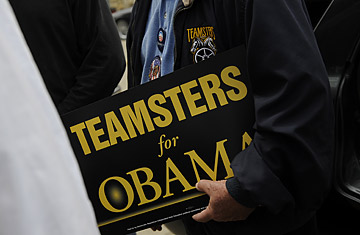
Still, having spent $80 million to help elect Obama, some unions are counting on the Democrat to deliver on his campaign promise. As Gerry McEntee, head of the American Federal of State, County and Municipal Employees candidly told the Washington Times (much to the delight of Republicans, who broadcast his remarks in press releases), "the payback would be the Employee Free Choice Act — that would be a vehicle to strengthen and build the American labor movement and the middle class." Still, in this economic climate, payback for anything will likely be difficult.