

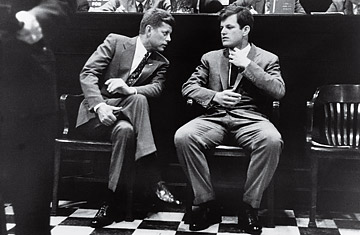
Presidential contender Jack gives his brother some advice during a 1960 campaign stop.
(2 of 3)
Quite a set of clothes had been laid out for that young man. In his mind and in the eyes of many others, he was flying toward the Navy Cross and, beyond that, a career in politics that would take the first Irish Catholic to the White House. With Joe Jr. gone, John Kennedy put on the outfit. He was a sickly, slight, half-crippled young man, but he managed to swell himself to size through cunning and courage and cortisone. Old-style politics, in the form of Chicago's Daley machine, boosted him across the Oval Office threshold. But as soon as he landed, the Kennedy mythmakers went to work vacuuming up the grit. The scaffolding of ward bosses was removed to reveal the polished image of a prince.
What John F. Kennedy was: cool under pressure, a shrewd decision maker, an inspiring speaker, a man who could learn from his mistakes. What he wasn't: a devoted husband, a vigorous athlete, a martyred saint, a budding King Arthur. With his sudden, shocking death, however, these truths were transmuted, through understandable grief, into the gauzy unreality of Camelot.
Thus the weight of two unrealized lives dropped onto Robert's shoulders. He added a deeper dimension: a mission of compassion to go along with the steel and the wit and the will to win. And then, with a gunshot in a Los Angeles hotel, everything fell to Ted--the youngest, the mama's boy, the slipstreamer.
This was a young man who scored the only Crimson touchdown in the 1955 Harvard-Yale game, who won the moot-court competition at the prestigious University of Virginia School of Law, who became the youngest majority whip in Senate history. And yet, because success was never enough among those brothers, Ted Kennedy cast the shadow of an underachiever. There was always someone faster, smarter, more powerful, more glamorous, ruthless or suave. Perhaps, as the youngest, he didn't realize that the same had been true of his brothers before the mantle had fallen on them. According to Leamer, Rose Kennedy couldn't imagine that her smaller, weaker second son could be the equal of her first: "I didn't think you could have two in one family," he quotes her as saying. Publisher Henry Luce reported a conversation with Joseph P. Kennedy: "He told me once that he didn't think Jack would get very far, and he indicated he wasn't very bright." As for Robert: "In the high stakes of inheritance, Bobby seemed to have drawn the worst card," Leamer writes. "Unlike his brothers, he wasn't a handsome child ... scrawny and small, always struggling to keep up."
In his memorable eulogy for Robert, Ted Kennedy seemed to cherish the possibility that what was real about his family might possibly be enough. "My brother need not be idealized, or enlarged in death beyond what he was in life," the young Senator said in a voice cracked by grief. But by that point, he was arguing against a hurricane. Death, normally the great leveler, had become the ennobler of the Kennedys. One by one, they had passed into immortality, leaving Ted alone among the men of the family to live a full span. His brothers became the sweetened distillate of their best days and handsomest poses, while he made his way through more-mottled seasons, merely human, with all that humanity entails--the mistakes, misjudgments, weaknesses, appetites and fears. Could it be that the real Kennedy curse was not early death but long life, suffering by comparison to a mythical might-have-been?