

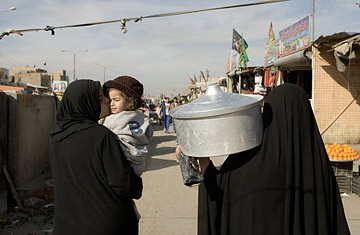
Shoppers walk the once dangerous al-Dora district
Like many retail districts in downtown Baghdad, al-Kindy Street has lately had little to offer shoppers but a fine assortment of fear, blood and death. Shootings and regular bombings have shuttered many of al-Kindy's stores, where some of Baghdad's wealthiest residents once bought everything from eggplants to area rugs. At this time last year, al-Kindy was deteriorating into just another bombed-out corner of a city spiraling out of control.
Then came the surge—President George W. Bush's controversial deployment, beginning last January, of an additional 30,000 U.S. troops, that seemed as tactically bold as it was politically unpopular. With his approval ratings ebbing and a bipartisan group of wise elders urging him to withdraw U.S. forces from Iraq, Bush went in the other direction. Overcoming the opposition of the Joint Chiefs, Bush sent five additional combat brigades to secure the capital, hunt down al-Qaeda in Iraq in the countryside and, at least in theory, stop the violence long enough for the country's Sunnis and Shi'ites to find common ground on power-sharing.
The surge's successes and limits are both plainly visible on al-Kindy today. A well-stocked pharmacy has reopened. A new cell-phone store selling the latest in high-tech gadgets opened in December. A trickle of shoppers moved along the sidewalks on a recent chilly morning as a grocer, who asked that his name not be used, surveyed the local business climate. "Things are improving slightly," he said. "But not as much as we hoped." Indeed, if al-Kindy is coming back, it is doing so slowly, unevenly—and only with a lot of well-armed help. Sandbagged checkpoints stand at either end of al-Kindy, manned by Iraqi soldiers with machine guns. Iraqi police in body armor prowl back alleys and side streets to intercept would-be car bombers. U.S. military officials often point visitors to al-Kindy Street as a metaphor for what is working—and what remains undone. "We still have some work to do," says Lieut. General Ray Odierno, the No. 2 U.S. commander in Iraq. "I tell everybody we've opened a window. There's a level of security now that would allow [Iraqi politicians] to take advantage of this window in time, pass the key legislation to bring Iraq together so they can move forward. Are they going to do that? In my mind, we don't know."
One year and 937 U.S. fatalities later, the surge is a fragile and limited success, an operation that has helped stabilize the capital and its surroundings but has yet to spark the political gains that could set the stage for a larger American withdrawal. As a result of improving security in Iraq, the war no longer is the most pressing issue in the presidential campaign, having been supplanted by the faltering U.S. economy. Voters still oppose the war by nearly 2 to 1, but Democrats sense the issue could be less galvanizing as troops begin to return home. Republicans who supported the surge, like Arizona Senator John McCain, have been trying out tiny victory laps lately, but because the hard-won stability could reverse itself, both parties are proceeding carefully. Interviews with top officials in Baghdad and Washington and on-the-ground assessments by Time reporters in Iraq reveal why the surge has produced real gains—but also why the war still has the capacity to cause collateral damage half a world away.
Bush's Plan—and Saddam's
It is an enduring mystery of the Bush White House that no one seems to know exactly when, how or why Bush decided to invade Iraq in 2003. But no such confusion clouds how the surge of 2007 was hatched. In December 2006, even as the Iraq Study Group was urging the President to begin a staged withdrawal from Iraq, another group of experts was putting together a very different plan. Fred Kagan of the American Enterprise Institute and retired Army General Jack Keane began calling not for a pullout but for an escalation of troops—a one-time infusion of combat soldiers to push the insurgents out of Baghdad. The Kagan-Keane plan found an eager audience at the National Security Council and with Vice President Dick Cheney. Within days, the plan had been sold to Bush, who pulled out a lot of stops to persuade the Pentagon—as well as colleagues in Congress. One Republican lawmaker, having watched his party lose control of both houses because of the war just a few months before, told Bush in a White House meeting that he would support the surge but that the strategy was a little like throwing a Hail Mary on fourth down. At about the same time, Bush told General David Petraeus, the top U.S. general in Iraq, that he would be getting additional troops.
Petraeus and his commanders had gotten a lucky break when U.S. forces raided an al-Qaeda command-and-control center in Taji, north of Baghdad. Captured in the raid, Odierno tells Time, was a map of Baghdad that outlined al-Qaeda's plan to capture and control the "belt" cities around the capital and then use those as logistical hubs and staging areas from which to mount attacks on U.S. forces inside the city. The telltale map suggested that to stabilize Baghdad, U.S. forces would also have to root out the troublemakers lurking outside the city. "A lot of people thought what we needed to do was put everybody into Baghdad to secure the population," says Odierno. "But what we really thought was causing the sectarian violence were the car bombs, the indirect fire [from mortars and rockets] and the suicide bombers. And we really thought their supply networks were in these belts."
At about the same time Odierno was targeting the Baghdad beltway, he tasked his staff to find out how Saddam Hussein had defended Baghdad against the many secret cells and gangs that wanted to upend his regime. The answer came back: Saddam had always maintained a complex perimeter around Baghdad that on paper looked like a series of concentric circles. Saddam had posted his Republican Guard in various towns that ringed the capital, and inside the city, he had stationed his Special Republican Guard. If it had worked for Saddam, thought Petraeus and Odierno, it might work for them against the insurgents.
But they had to wait. Though Bush announced the surge in January 2007, several months would pass before all 30,000 additional troops reached Iraq and took up their positions. As the troops deployed, Petraeus and Odierno mounted a string of offensive operations against al-Qaeda and insurgent strongholds all over Iraq: in Baghdad, in the belt towns and in cities deeper to the north and south. The idea was to shake the bad guys loose and then chase them down. Even with the extra troops, Odierno and Petraeus didn't have the forces to do this everywhere, but they dispersed their forces so widely that it seemed that way for a while.