

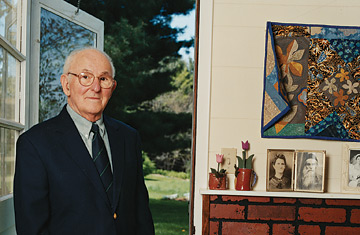
Jacob "Jack" Neusner photographed at his home in Rhinebeck, New York on May 10, 2007.
(2 of 2)
In fact, a close reading of the Pope's chapter suggests more a marriage of convenience. Benedict is preoccupied with what he sees as the Gospel's overriding message of Jesus' divinity, even in passages that liberal Christians read primarily as straightforward injunctions to help the poor and powerless. Having a rabbi help make that case is novel and convenient. Regarding one verse, Benedict writes that "Neusner shows us that we are dealing not with some kind of moralism, but with a highly theological text, or, to put it more precisely, a Christological one." He acknowledges the rabbi's point that Jesus is offering the Jews a transformation rather than a continuation of the Torah but maintains that the trade-off is worth it, provided Jesus is not merely "a liberal reform rabbi" but "the Son." That Neusner and other Jews regard that very Sonship as a deal breaker does not bother him much. "It would be good for the Christian world to look respectfully at this obedience of Israel," he writes, "and thus to appreciate better the great commandments" as universalized by Jesus.
Neusner, in his Rhinebeck, N.Y., home, is equally unfazed by the Pope's repurposing of his argument. "You can't expect him to get circumcised," he says. "He's still a Christian, and I'm still a practitioner of Judaism. But the two positions can consider the same text and identify where they converge and where they part company. I think it's terrific."
So do other players in the Jewish-Christian conversation. "'Pope Takes Seriously What Rabbi Has to Say' is a message that will be picked up by anyone who reads their diocesan paper," says Fisher of the Bishops' conference. Amy-Jill Levine, a Jew who teaches New Testament studies at Vanderbilt University Divinity School and has her own Jesus book, The Misunderstood Jew, says both undergrads and interfaith experts can profit from the Neusner-Benedict exchange. Rabbi James Rudin, senior interreligious adviser to the American Jewish Committee, says it is in some ways "the full maturation of the modern Catholic-Jewish encounter." But perhaps it may mature further still. Asked what he would like to write next, Neusner says, "I'd like to do a book with the Pope about Paul," whose letter, Romans, contains verses that have long bedeviled Jewish-Christian relations. He is half-joking. But what if the Pope said yes? What new wonder might emerge when two smart men agree to disagree but then keep talking?