

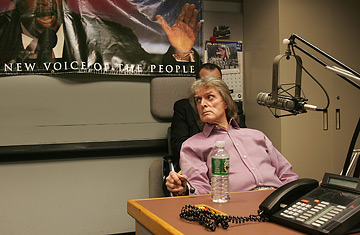
Radio show host Don Imus waits for the Rev. Al Sharpton's radio show to begin, on which Imus talked about complaints that he made racially charged comments in a recent broadcast April 9, 2007 in New York City.
Say this for Don Imus: the man knows how to turn an economical phrase. When the radio shock jock described the Rutgers women's basketball team, on the April 4 Imus in the Morning, as "nappy-headed hos," he packed so many layers of offense into the statement that it was like a perfect little diamond of insult. There was a racial element, a gender element and even a class element (the joke implied that the Scarlet Knights were thuggish and ghetto compared with the Tennessee Lady Vols).
Imus was a famous, rich, old white man picking on a bunch of young, mostly black college women. So it seemed pretty cut-and-dried that his bosses at CBS Radio would suspend his show--half frat party, half political salon for the Beltway élite--for two weeks, and that MSNBC would cancel the TV simulcast. And that Imus would plan to meet with the students he offended. Case closed, justice served, lesson--possibly--learned. Move on.
But a reasonable person could ask, What was the big deal? And I don't mean the lots- of-black-rappers-say-"hos" argument, though we'll get to that. Rather, I mean, what celebrity isn't slurring some group nowadays?
I exaggerate slightly. But our culture has experienced an almost psychotic outburst of -isms in the past year. Michael Richards and "nigger." Isaiah Washington and "faggot." Senator George Allen and "macaca." Mel Gibson and "f__ing Jews."
But we also live in a culture in which racially and sexually edgy material is often--legitimately--considered brilliant comment, even art. Last year's most critically praised comedy, Borat: Cultural Learnings of America for Make Benefit Glorious Nation of Kazakhstan, won Sacha Baron Cohen a Golden Globe for playing a Kazakh journalist who calls Alan Keyes a "genuine chocolate face" and asks a gun-shop owner to suggest a good piece for killing a Jew. Quentin Tarantino has made a career borrowing tropes from blaxploitation movies. In the critics-favorite sitcom The Sarah Silverman Program, the star sleeps with God, who is African American and who she assumes is "God's black friend." And the current season of South Park opened with an episode about a Michael Richards--esque controversy erupting when a character blurts the word niggers on Wheel of Fortune. (He answers a puzzle--N--GGERS--for which the clue is "People who annoy you"; the correct answer is "naggers.")
This is not to say that Borat made Imus do it or to make excuses for Imus. Even in the midst of his apology tour last week, Imus did enough of that for himself, citing his charity work, his support of black Senate candidate Harold Ford Jr., even his booking the black singing group Blind Boys of Alabama on his show. (He didn't mention how, last fall, he groused about persuading the "money grubbing" "Jewish management" to okay the booking.)
But in the middle of his stunning medley of sneer, apology and rationalization, Imus asked a pretty good question: "This phrase that I use, it originated in the black community. That didn't give me a right to use it, but that's where it originated. Who calls who that and why? We need to know that. I need to know that."
So let's ask.
Imus crossed a line, boorishly, creepily, paleolithically. But where is that line nowadays? In a way, the question is an outgrowth of something healthy in our society: the assumption that there is a diverse audience that is willing to talk about previously taboo social distinctions more openly, frankly and daringly than before. It used to be assumed that people were free to joke about their own kind (with some license for black comedians to talk about how white people dance). Crossing those lines was the province of the occasional "socially conscious artist," like Dick Gregory or Lenny Bruce, who was explicit about his goals: in Bruce's words, to repeat "'niggerniggernigger' until the word [didn't] mean anything anymore."
Now, however, we live in a mash-up world, where people--especially young people--feel free to borrow one another's cultural signifiers. In a now classic episode of Chappelle's Show, comic Dave Chappelle plays a blind, black white supremacist who inadvertently calls a carload of rap-listening white boys "niggers." The kids' reaction: "Did he just call us niggers? Awesome!" The country is, at least, more pop-culturally integrated--one nation under Jessica Alba, J. Lo and Harold & Kumar--and with that comes greater comfort in talking about differences.
But that's a harder attitude for older people--who grew up with more cultural and actual segregation--to accept or to mimic. Part of the problem with Imus' joke was that it was so tone-deaf. "That's some rough girls from Rutgers," he said. "Man, they got tattoos ... That's some nappy-headed hos there." The joke played badly in every community, raising memories of beauty bias (against darker skin and kinkier hair) that dates back to slavery. Tracy Riley, 37, of Des Moines, Iowa, who is of mixed race, said the incident was among her four kids' first exposures to overt racism. "Our kids don't see color the way we do," she said. "They don't see it as much. 'You're my friend or not, but it's not about race.'"
The line was as damning as anything for what it suggested about Imus' thought process: a 66-year-old white male country-music fan rummaging in his subconscious for something to suggest that some young black women looked scary, and coming up with a reference to African-American hair and a random piece of rap slang. (Maybe because older, male media honchos are more conscious of--and thus fixated on--race than gender, much of the coverage of Imus ignored the sexual part of the slur on a show with a locker-room vibe and a mostly male guest list. If Imus had said "niggas" rather than "hos," would his bosses have waited as long to act?)
So who gets to say "ho," in an age when Pimp My Ride is an innocent car show and It's Hard Out Here for a Pimp is an Oscar-winning song? As even Essence Carlson, one of the Rutgers students Imus insulted, acknowledged at a press conference, black rap artists labeled young black women as "hos" long before Imus did. And while straight people may not be able to say "faggot," Queer Eye for the Straight Guy and Will & Grace helped mainstream the nonhostile gay joke for straight people. But all this reappropriation and blurring--distinguishing a good-natured "That's so gay!" from a homophobic one--has created a situation in which, when Richards went off on his Laugh Factory rant, it was possible to wonder if he was playing a character.